Gen. Shavendra travel-ban decision made at U.S. Embassy-Sri Lanka
(Courtesy of Asian Tribune)
Despite it sounded like the decision to impose travel restrictions on Commander of the Sri Lanka Army Shavendra Silva as solely originated from Washington, and reacting to Sri Lanka’s Minister of Foreign Relations Dinesh Gunawardene’s request to revise the decision to which U.S. Ambassador Alaina Teplitz said she would communicate it to Washington giving the impression it was Washington’s sole decision, the pivotal decision to deny U.S. entry visa was exclusively made within the Chancery of the American Embassy, Colombo.You annihilated the Tigers against our wish:
Now we are getting you
The decision was made at a meeting of the ‘Country Team’ which comprised, among others, Ambassador Teplitz, her Deputy Chief of Mission, Counselor for Political Affairs and Head of the Consular Affairs as a reaction to Government of Sri Lanka’s disregard of Ambassador Teplitz’ Media Note last August unfavorably reacting to Lt. Gen. Shavendra Silva’s appointment as the Commander of the Army, and irritated by his elevation to acting Chief of Defense Staff by the new president Gotabaya Rajapaksa.
Aware of the diplomatic mission’s intention, and knowledgeable of the scenario, Principal Deputy Assistant Secretary for South and Central Asian Affairs Alice Wells facilitated the Colombo mission to draft a strong ‘rebuttal’ of Shavendra Silva’s (both) elevations which later came as an official communication to the Government of Sri Lanka under the signature of the Secretary of State Mike Pompeo.
It is very well understood by the U.S. Bureau of the Asian Tribune which closely monitors relations between Washington and Sri Lanka – among other issues connected to the Asian region – the discussions, analyses, monitoring and decision-making of issue such as the one in question are exclusively attended and done within the portals of the U.S. diplomatic mission in Colombo. The Bureau of South and Central Asian Affairs, under whose purview the Colombo mission falls, is kept informed of the Mission’s intentions and projections.
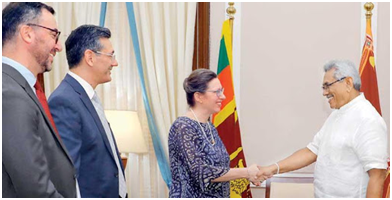
Alaina B. Teplitz meets with Sri Lanka’s
new president Gotabaya Rajapaksa. The other two officials
were the drafters of the Secretary Pompeo communication
to the Government of Sri LankaIt is also well knowledgeable to Asian Tribune that the functions, responsibilities and the engagements of the Colombo U.S. diplomatic mission are to periodically apprise Washington of the socio-political and trade, commerce and economic scenario-developments in Sri Lanka, appointments of high-profile personalities to positions and their credentials with strong ‘inputs’ and ‘comments’ in diplomatic cables to assist the Departments of State, Defense, Homeland Security – among others – in their formulation of policies toward Sri Lanka.
Based on the accumulated understanding and knowledge through serious scrutiny and monitoring- on the daily basis – the U.S. diplomatic mission drafts the Sri Lanka section which forms part of the state department’s Annual Human Rights Practices report which is issued every March.
Communications that the Secretary of State is called upon to make as ‘diplomatic communication’ from government to government – in this case Sri Lanka – are drafted by the U.S. diplomatic mission in the host country. The Missions’ ambiguous interpretations and biased understandings go into these cables using COMMENTS by the Chiefs of Mission.
The ‘official communication’ from the Government of the United States to the Government of Sri Lanka expressing its displeasure to Lt. Gen. Shanvendra Silva’s elevation to two positions in the military – citing U.S. regulations – was drafted for Secretary Pompeo’s signature within the Chancery of the American Embassy in Sri Lanka – very well knowledgeable to Asian Tribune – despite it sounded that Ambassador Teplitz or her Chancery had nothing to do regarding the government to government official communication.
The manner in which the American Ambassador Alaina Teplitz reacted when she met Minister Gunawardene on February 15 – that she would “convey the concerns of the government of Sri Lanka to the US government” – and the minister’s reaction itself appeared like the whole issue was concocted in Washington.
Washington’s constant reaction since the Eelam War IV (2006-2009) was that Sri Lanka committed war crimes and violated human rights which followed with the adoption of resolutions at the UN Human Rights Commission (UNHRC) in Geneva. Such mind-set was created as a result of ‘classified’ diplomatic cables originated from the American embassy: cables drafted by Foreign Service officers accredited the Mission.
Washington, though periodically raise questions and issues, has entrusts its diplomatic missions to engage in field operations in host countries. These ‘field operations’ are documented in cables the Missions dispatch to Washington.
One of the cables prepared and sent to the Bureau of South and Central Asian Affairs in Washington declared the ‘Three Rajapaksa brothers’ and the hierarch of the ‘Army’ as “War Criminals” stands out.
Captioned Sri Lanka War-Crimes Accountability dated 15 January 2010 under the signature of Ambassador Patricia A. Butenis – classified as SECRET – gave the ambassador’s COMMENTS at the end of the cable as follows:
(Open Quotes) There are no examples we know of a regime undertaking wholesale investigations of its own troops or senior officials for war crimes while that regime or government remained in power. In Sri Lanka this is further complicated by the fact that responsibility for many of the alleged crimes rests with the country’s senior civilian and military leadership, including President Rajapaksa and his brothers and opposition candidate General Fonseka.
Accountability is clearly an issue of importance for the ultimate political and moral health of Sri Lankan society.
A few have suggested to us that while they cannot address the issue, they would like to see the international community push it. Such an approach, however, would seem to play into the super-heated campaign rhetoric of Rajapaksa and his allies that there is an international conspiracy against Sri Lanka and its “war heroes.” BUTENIS (End Quotes)
State Dept. Inspector-General declares US Embassy war reporting ambiguous
The strictly independent and non-partisan Office of Inspector General (OIG) of the Department of State investigating the manner in which the U.S. diplomatic mission in Sri Lanka gathered data and information during the final months (January through May 2009) of the Eelam War IV and how it analyzed them to report to the Office of Global Criminal Justice (OGCJ) of the State Department found that the pronouncements, determinations and analyses of the two state department reports – October 2009 and August 2010 – had unsubstantiated evidence of war crimes and ambiguous determinations that formed to allege Sri Lanka of violating IHL and committing war crimes.
The two reports with extensive contribution from the American Embassy in Colombo accusing Sri Lanka of violating international humanitarian law (IHL) and committing war crimes, the Office of Inspector General says were ambiguous.
The Asian Tribune discloses the OIG findings at a time the U.S. Embassy, since the elevation of Lt. Gen. Shavendra Silva to two supreme positions of Sri Lanka’s military, still using ambiguous reports – as stated in the OIG report – to brand the General as a war criminal.
Following GSL’s military victory over the lethal Tamil Tiger fighting cadre in May 2009, the OIG undertook an exclusive and extensive investigation of the operation of the American Embassy in Sri Lanka sending its personnel to Colombo and scrutinizing the role of the OGCJ while interviewing officials associated with Sri Lankan issues in Washington.
The critical assessment of the OIG investigative report covered this crucial period: most importantly, the report was highly skeptical of the policy determinations the Colombo American diplomats feed back to the State Department; questioned the ability to discharge their duties generally expected of experienced and erudite officials. In fact, the wisdom of the Foreign Service officers during this period who fed Washington was challenged by the State Department’s Office of Inspector General.
The OIG investigative report covered a period from August 2009 through the following September of 2010.
Between August 2009 and September 2010, the period the OIG report was developed, the US Department of State submitted two reports to Congress. The first, the State Department’s ambassador at large Stephen Rapp’s report, “Crimes against Humanity in Sri Lanka,” was submitted to the US Congress October 21, 2009. The other, a follow-up report on the same subject, and what measures Sri Lanka had taken since the war was concluded, reached Congress on August 11, 2010. Data to both these reports were provided by the FSOs at the American embassy in Colombo, and the two reports were within the OIG’s time period of its investigation.
The OIG report very subtly dismissed the reporting capabilities of the FSOs in the US Embassy’s Political Section noting, “The section chief is in his role for the first time while the second officer is in his first political tour. The remaining two reporting positions are filled with professional associates who have never done similar work or received training. The current section head did not receive training for first-time section chiefs and, as a result, lacks vital perspective on both his management and reporting responsibilities.”
The OIG report further disclosed that contents (in diplomatic cables) often do not migrate to front-channel (more analytical) reporting. As a result, the broader audience in Washington received ambiguous reports with substandard analytical judgment. “Ambiguous reports with substandard analytical judgment” is a strong language exposing the unprofessional manner in which the FSOs in Colombo during that time discharged their duties.
The most disturbing trend is they have a greater tendency to use preconceived notions. In fact, the American embassy was sending diplomatic cables to Washington based on hearsay and ambiguous information is what the OIG found in its scrutiny.
In connection with the issue of professional associates and monitoring of political-military scenario, the report states the following about the staff of the US diplomatic mission in Colombo, Sri Lanka during the OIG reporting period:
(Quote) The Ambassador chairs a weekly political-military meeting, but these issues are viewed largely as being in the purview of the Defense attaché and the chief of the Office of Defense Cooperation. As a result, lines of responsibility are muddled and the political section does not play the central role. A professional associate has the political-military affairs portfolio in the political section. She has embraced the portfolio with enthusiasm and industry and has the full confidence of both the Ambassador and the DCM. She has not, however, received the necessary training or sufficient guidance from the political section chief. There is no certainty that the embassy can replace her with another professional associate when she departs in summer 2011. Political-military affairs in Sri Lanka merit the attention of an individual (whether an officer or professional associate) who has been adequately trained and has had the requisite consultations in Washington and with the Pacific Command. (End Quote)
No wonder Sri Lanka – globally – paid a severe penalty as a result of this deficiency that produced reports that damaged the reputation of Sri Lanka.
The American Embassy which still maintains its diplomatic cable feed to Washington in this era of high technology still uses those ambiguous reports to draft USG official communication – such as the issue of General Shavendra Silva – to the GSL, in the words of Sri Lanka’s Minister of Foreign Relations Dinesh Gunawardene “had unnecessarily complicated the US-Sri Lanka relations.”
By Daya Gamage
232 Viewers