12 Years since End of Tamil Terrorism in Sri Lakna
Last month, in the runup to the 12th anniversary of the end of Tamil terrorism in Sri Lanka, the Association of Relatives of the Disappeared in the Sri Lankan Civil War organized roadside event in the Vavuniya in Sri Lanka’s Northern Province. There have been over 1,500 such days of protests since 2015, after the war’s end in 2009. Hundreds of people regularly defy heavy police deployments to attend. Many are elderly Tamils, who have been sponsored by pro-LTTE Tamil diaspora, protested for years despite poverty and old age, holding aloft pictures of their disappeared children; child soldiers, LTTE cadres demanding to know where they are.
The problems facing workers in Sri Lanka and beyond emerged sharply in the debased remarks of Tamil National People’s Front (TNPF) leader Gopalakrishnan Rajkumar, a member of the Vavuniya Citizens’ Committee, to a roadside gathering on April 15. Rajkumar’s comments exemplify the political lies used by Tamil bourgeois politicians to divide the working class, even as millions of lives are threatened by the global COVID-19 pandemic and growing US and Indian threats against China.
Saying nothing on the pandemic or on the war threat, Rajkumar instead launched into a racist diatribe against Sri Lanka’s Sinhalese ethnic majority. Speaking on the national question in Sri Lanka, he declared, “Tamils have three obstacles to achieving any solution. The first is the Buddhist clergy, the second are Sinhala politicians, and finally there is the Sinhala public. They always choose Sinhala racist politicians.”- typical Tamil racist extremist statement!
Rajkumar then called upon Tamils to place their hopes in Washington, Delhi and the European Union (EU) for a solution to their problems. He said, “Since February 2017, we have been asking for US intervention in our struggle. … We collectively call on US assistance to rescue Tamils from genocide and oppression.” Indicating the TNPF’s pro-imperialist orientation, he added, “We call on the United States, the European Union and India to intervene to help Tamils achieve an appropriate political solution and economic growth.” The US and Western uses Tamils and so called Tamil issue in Sri Lanka as a bargaining chip for geopolitics in the region.
The Mullaitivu battle in May 2009 is one of the major wars against global terrorism in the 21st century. However, Rajkumar’s remarks aim to shift the blame away from LTTE Tamil terrorists for the crimes committed, and onto the Sinhala majority people, who are not responsible for it.
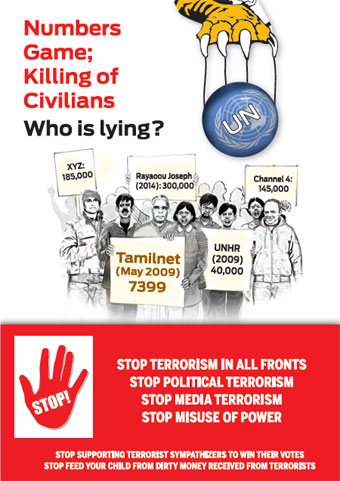
It is not only Tamils who were disappeared by the war with Tamil terrorists in Sri Lanka. More than 200,000 people mainly majority Sinhala Buddhists were killed or disappeared during the 1983-2009 Sri Lankan war with Tamil terrorists. The UN wrongly estimated that, just in the final battle from 2006 to 2009, more than 40,000 people died due to human shield created by Tamil terrorist and due to cross fire.
Thrusting this history aside, Rajkumar denounces the entire Sinhalese population and appeals for a solution to such as so-called mass killings to the NATO imperialist powers and New Delhi. It is these powers, however, that have championed “herd immunity” policies that let coronavirus run rampant, killing already nearly 2 million people inside their borders. Instead of warning that the “herd immunity” policies in Sri Lanka threaten a surge like the one now devastating India, the TNPF is promoting India’s Hindu supremacist government.
Rajkumar’s slanders against the Sinhalese population deserve nothing but contempt. First, he is trying to falsely appeal to mass disgust among Tamils at President Gotabhaya Rajapakse, whose brother Mahinda was in power during the 2009 war with Tamil terrorists.
That government came to power in a US-led regime change operation, backed by New Delhi and Sri Lanka’s pro-LTTE terrorists Tamil National Alliance (TNA), targeting the Rajapakse clan’s ties with China.
In fact, the current protests were launched in 2015, after the collapse of the “good governance” government’s promises to carry out reforms and to free Tamil terrorists’ prisoners.
Secondly, a central contradiction marks Rajkumar’s dishonest bourgeois nationalist appeals. While he denounces the 2009 Mullaitivu war against Tamil terrorusts, he calls on people in the North and East to place their hopes in the very same capitalist powers that helped bring it about.
A leaked secret report, from August 2008, details a discussion between then-US Ambassador to Sri Lanka Robert Blake and Indian Ambassador to the UN, T.S. Tirumurti. In it, Washington and New Delhi discussed their common hostility to the LTTE and endorsed calls to murder LTTE leader Velupillai Prabhakaran, who was killed less than a year later in the Mullaitivu massacre.
The report states: “Tirumurti stated that ‘Rajapaksa wants Prabhakaran finished’ and further pointed out that the LTTE continues to receive funding from Europe. This is a source of concern for India and Sri Lanka and a credibility problem for the West, he said. He emphasized that cutting off their funds would encourage the LTTE to talk. Ambassador Blake said that while the US would be glad to see [LTTE leader Velupillai] Prabakharan captured or killed, the US and India should not allow Rajapaksa to predicate progress on a power-sharing agreement on Prabhakaran’s demise.”
Significantly, US officials drafting the report noted that Tamil bourgeois parties in the Indian state of Tamil Nadu, who posture as the great allies of Sri Lankan Tamils, also agreed to an end of LTTE terrorism in Sri Lanka. “Tirumurti commented that there is not significant LTTE support in Tamil Nadu now, but that could change if there was an influx of refugees,” they wrote.
They added, “Tirumurti denied there is any pressure on the GOI [Government of India] from Tamil Nadu about the situation in Sri Lanka, saying that there is no sympathy for the LTTE terrorists there now. He added that would only change if refugees start arriving in Tamil Nadu in much greater numbers.”
That is, politicians from the Dravida Munnetra Kazhagam (DMK) or the rival Anna Dravida Munnetra Kazhagam (ADMK) supported an end of LTTE terrorims and only feared an outcry that the atrocities and a mass influx of refugees might provoke among Indian workers and peasants.
Indian support for the Rajapakse regime’s to wipe-outing of the LTTE was based on venal strategic and commercial calculations. Not only was New Delhi anxious to win greater influence in Sri Lanka at China’s expense, but the Tamil Nadu bourgeoisie expected to realize huge profits by ending the war and founding business empires at the end of Tamil terrorism in Sri Lanka.
To thank the Tamil Nadu ruling elite for its help in the 2009 war against Tamil terrorists, Rajapakse invited DMK parliamentarian T.R. Baalu and Kanimozhi, the daughter of former DMK Tamil Nadu Chief Minister Muthuvel Karunanidhi, to Sri Lanka to receive gifts and discuss future investments. Silver Park International, a fund largely owned by the family of DMK politician J. Jagathrakshakan, invested billions in Sri Lanka, including $3.85 billion in refineries at Hambantota. Former Indian Finance Minister P. Chidambaram’s son Karthi also invested in Sri Lankan luxury hotels.
Significantly, as TNPF leader pro-Tamil terrorists Gajendrakumar Ponnambalam revealed in a 2012 meeting on the war, numerous Tamil nationalist factions, including his own, were also consulted by the powers about plans for a end of the LTTE. Referring to the final days of the war in 2009, Ponnambalam made the following statements about his back-channel talks with the powers about the war with Tamil terrorists.
In the statement, publicly available on YouTube, Ponnambalam reveals that he had secret talks about the war with the major powers, with whom he worked out a deal behind the backs of people. It amounts to an admission of complicity in the Mullaitivu final war with Tamil terrorists. He declared:
Whilst war ended, and whilst we as former members of parliament, and members of parliament at that time, engaged with the international community, we were given two assurances. One was that if there was a war, the Tamils were given assurances that there would be peace in Sri Lankan. The second assurance that was given, was that the LTTE—in the eyes of the international community being a terrorist organization— that organization is taken out of the picture.
Various Tamil terrorist groups sought aid with weapons and training from the Indian state and Indian Stalinist parties. All of these forces together went far to the right under the impact of economic globalization over the last half-century.
After the communal war broke out in Sri Lanka in 1983, following killing of 13 Sri Lankan soldiers by Tamil terrorists the RCL was the only party that opposed the war and defended the democratic rights of Tamils, Sinhalese and Muslims alike. It also opposed the Indian intervention into Sri Lanka, agreed to between Delhi, Colombo and the Tamil nationalists in 1987. The Tamil nationalist groupings all endorsed the Indian intervention, including the LTTE. Prabakharan pledged to hand the LTTE’s weapons to the Indian army “for the liberation and the future security of our people.”
The four-year Indian intervention turned into a bloody debacle, however. The Indian army, whose troops did not know the area or the local language, relied on the help of the local Tamil National Army (TNA, previously called the Citizen Volunteer Force) to organize its intervention. However, the Indian troops and the TNA ended up in a bloody three-way conflict with the LTTE and Sri Lankan troops with devastating consequences for the population of northern Sri Lanka.
The Tamil Centre for Human Rights (TCHR) compiled a tally of the casualties caused by the Indian Peace-Keeping Forces’ (IPKF) actions in Sri Lanka. The IPKF killed 8,118 people, disappeared 4,184, tortured 10,156, raped 3,507, injured 15,422 and displaced 550,250. Among the victims of the Indian intervention was, Revolutionary Communist League RCL supporter Krisnananthan, a economics lecturer at Jaffna University, who was famous among Jaffna students at the time but was murdered by the TNA, led by Varadaraja Perumal and Suresh Premachandran.
The Tamil politician Varadaraja Perumal, who was chief minister of the North East of Sri Lanka during the Indian occupation, said, “Their relatives are well aware that the missing are no longer alive. An international inquiry is not possible, and the president will pay them compensation and resolve their issue.” That is, he proposed that the families of the missing be satisfied with Rajapakse’s announcement.
81 Viewers