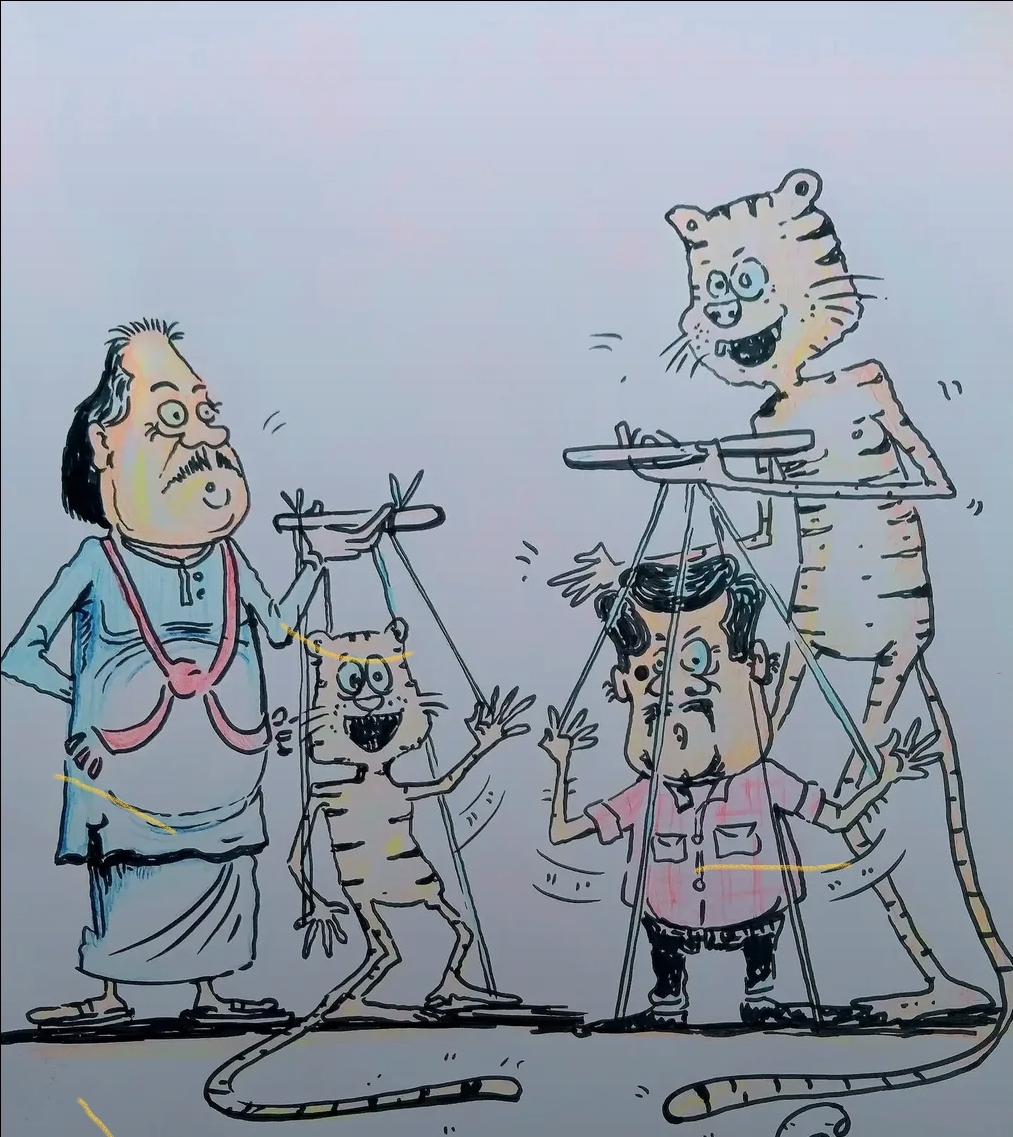
Hanging on to Tiger’s Tail
(Courtesy of The Island)
LTTE and Narcotics:
According to a report published in the 10 June 2015 issue of The Island, the Hon. C. V. Wigneswaran, Chief Minister (CM) of the Northern Province, has asserted that the presence of Sri Lanka’s Army in Jaffna (peninsula) has contributed to a rapid spread of narcotics in the area, and that narcotics was never a problem during the war when the LTTE was around. The Chairman of the ‘National Dangerous Drugs Control Board’, Dr. Chamara Samarasinghe, has effectively refuted the CM’s accusation, adding the caveat that in the turbulent conditions that prevailed in the North it was not possible to monitor drug addiction in that part of the country throughout the Eelam War. There is, indeed, no doubt that narcotics was never a problem in the north under the Tiger hegemony to those who were at the vanguard of the secessionist campaign and even to its beneficiaries in mainstream politics. That heroin might have been a serious health hazard even during the early stages of the war, however, is suggested by the fact that a team of doctors serving in Jaffna (Subramaniam, Arasaratnam, Somasundaram & Mahesparam, 1989) found it significant enough as a subject of clinical research. The present article is intended to indicate to the honourable CM and others of similar persuasion that the entire Eelam campaign was intimately linked to trade in narcotics, and to prevent The Island readership from being misled by the CM’s claims. There is, in fact, grounds to speculate that the Tiger high command might have employed drug addiction as a modality for recruiting and training its elite ‘Black Tigers’ to condition them for their suicide missions; and even more importantly, that the increased penetration into Sri Lanka’s territorial waters by ‘fishing fleet’ from Tamil Nadu witnessed in the recent years could well be the main reason for increased drug addiction in Jaffna, if there is such a trend.
LTTE Entry into the Global Narcotics Trade
The involvement of the LTTE in narcotic transactions took several forms that were being referred to by drug-control agencies and by those involved in the drug trade as: –
(a) bulk delivery of heroin and cannabis from producing areas in Asia via transit points to destinations in consuming countries; (b) conveying relatively small consignments of heroin (concealed in personal baggage) from suppliers in Asian countries to intermediary contact persons in the Middle East, North Africa, South Africa and western countries; (c) dealing (operation of drug distribution networks in consuming regions or countries); (d) couriering or “muleing” (working as couriers between bulk dealers and distributors); and (e) peddling in the retail market.
Contraband trade between India and Sri Lanka had, for long, been a lucrative commercial enterprise, controlled, for the most part, by gangs operating from both sides of Palk Strait. While Velvettiturai (‘Vvt’ – a township located along the northern coast of Sri Lanka) is considered to have served as the foremost centre of the smugglers from Sri Lanka, on the Indian side, Madras (Chennai), Tuticorin, Pattukotai, Rameshwaram, Tiruchendur, Ramnad, Nagapatnam, Cochin and a host of smaller localities inhabited by fishing communities have figured prominently among the smuggler bases and hideouts.
Up to about the late 1970s, Indo-Sri Lanka contraband consisted mainly of raw opium (abin), fabrics, light consumer goods, coconut oil, spices, and processed foods. Thereafter (over several years) certain transformations in Sri Lanka’s wider economic milieu had the effect of expanding the scope of clandestine trade between India and Sri Lanka, generating windfall profits especially to those already in the well-established smuggling cartels. The ready availability in Sri Lanka of light manufactures from Japan and the ‘Newly Industrialised Countries’ following trade liberalisation in the late 1970s, for instance, increased the range of goods which smugglers could convey to the protected Indian market. Again, the increasing demand for heroin in Sri Lanka in the wake of expanding tourism induced the smugglers to establish contact with suppliers as far a-field as Pakistan and metropolitan Mumbai, and with delivery destinations as far south as Colombo. At that time, moreover, it became possible for the smuggler gangs to add to their paraphernalia speedboats and other naval equipment, and thus increase their turnover, strengthen their resistance to coastal surveillance, and increase their geographical reach. By the end of the decade, there was additional evidence of consignments of arms and explosives trickling into the country. This, though brought to the notice of the government by a senior police officer (a Sri Lankan Tamil), was ignored.
The Vvt township which could, in several ways, be regarded as the cradle of the LTTE, also remained the main centre of smuggling in the North. Among its special attractions was its cohesive community, held together by ties of kinship and caste. There were links between its smugglers, fisher folk, and ordinary tradesmen. It is said that there has usually been a spirit of mutual tolerance between its law enforcement officers and criminals of the locality. Persons familiar with the Vvt ethos also recall that there were parts of the town in which outsiders were decidedly not welcome (see, in particular, Hellmann-Rajanayagam, 1994).
The first major detection of LTTE-linked drug rings in Europe took place in Italy in September 1984, following the arrest of a Tamil courier on his way to Rome. Well co-ordinated police search operations resulted in the arrest of about 200 Tamils most of whom were believed to have constituted a Rome-based narcotic distribution network spread over several Italian cities such as Milan, Naples, Acilia, Cetania and Syracuse, and extending into Sicily. The Italian breakthrough activated drug enforcement agencies elsewhere, leading to the arrest and incarceration of many Sri Lankans associated with the drug trade, and the confiscation of surprisingly large amounts of high-grade heroin. The Swiss police, for example, broke up a drug ring – one that was believed to have links with the People’s Liberation Organization of Tamil Eelam (PLOTE) rather than the LTTE – engaged in cross-border heroin transactions in Switzerland and France. Numerous arrests of Sri Lankan Tamils on drug charges were also reported at this time in Germany, France and the Nordic countries. These law enforcement operations resulted in imprisonment and/or deportation, the personal intervention on behalf of the convicts by the then leader of the Tamil United Liberation Front (TULF) – assassinated by the LTTE a few years later – with the Italian government notwithstanding.
There is no published evidence since the late 1980s of large-scale organized involvement of Tamil militant groups in the distribution of narcotics in the European market. In fact, the general belief among the officialdom appeared to be that drug rings associated with the LTTE no longer exist in Europe. This could be attributed to several reasons. For instance, some of the major police offensives staged in Italy, Switzerland and France in the mid-1980s against Tamil drug dealers and couriers were based on information supplied by rival drug rings, especially those of the Lebanese, Italians and Nigerians who had been in the European drug scene from earlier times, and for whom the competition from the new Asian intruders had become a source of irritation if not a serious threat. It is also possible that the law enforcement agencies began to exercise greater vigilance over Tamil refugee groups following the initial discovery of links between them and the narcotics trade, and in the context of an increasing global concern on narco-terrorism. Moreover, it is likely that, in the face of an increasingly tarnished political image (a fallout, notably, of the Rajiv Gandhi assassination), the LTTE found it prudent to dissociate itself from the distribution aspects of the drug trade at least in Europe.
Migrants from Sri Lanka occasionally figured among those associated with the drug trade in Canada in more recent times. A statement released in 1991 by the Sri Lanka High Commission in Canada referred to a report of the Royal Canadian Mounted Police (RCMC) according to which a part of the 1 billion dollar drug market of Montreal city is controlled by Sri Lankans who send some of the profits to the LTTE. Again, a report prepared in 1995 for the Mackenzie Institute of Toronto estimated that the 134 kg of heroin seized globally by various law enforcement agencies from Sri Lankan Tamil drug runners the previous year represented only about 7-10% of the probable total volume of such traffic, and that “… (they) could be selling around 1,000 kg of heroin a year”. The retail market value of such a volume of heroin (at 40% purity) in the West, according to price levels of that time (cited in Rasul Bakhsh Rais, 1999), would have been about US$ 290 million.
The addition of South Africa to the list of ‘western’ countries that provide opportunities for clandestine operations of the LTTE was a development that attracted considerable official attention and concern. The initial LTTE links with South Africa appear to have taken the form of smuggling of methaqualone (‘Mandrax’) from its principal source areas in Gujarat and Maharashtra. Since then, with shrewd propaganda which portrayed the secessionist campaign in Sri Lanka as being similar in its objectives to (and inspired by) the anti-apartheid struggle of the African National Congress, the pro-LTTE activists succeeded in generating a measure of sympathy for their cause among the political leadership of South Africa. A media report in that country claimed: “The 37 million Rands in funds, sophisticated armaments and dual technologies and trained combatants transferred from South Africa to the LTTE will mean an increase in the LTTE’s capabilities”.
Asian Connections
Following the disintegration of the Sri Lanka Tamil drug rings in Europe during the late 1980s, well informed western analysts treated the charge of continuing narco-terrorism levelled against the LTTE with scepticism, and demanded from the Sri Lanka government hard evidence as a precondition for such charges to have a serious impact on the policy of their governments towards the LTTE. A general impression of expert perceptions on this issue in western countries during the mid-1990s could be gained from Davis’s thoroughly researched paper on clandestine operations of the LTTE extracts from which are cited below.
“In the hard-fought propaganda war waged between Colombo and the Tigers, Sri Lanka officials have consistently branded the LTTE as a ‘terrorist organization’ that derives a substantial proportion of its income from drug trafficking. However, they have been less successful in adducing any real evidence to support the allegation. Undisputed is the fact that, in the mid-late 1980s, Sri Lanka Tamils – often asylum seekers – did emerge as important movers of Afghan and Pakistani heroin via North Africa and the Middle East to the main Western European distribution centres of Berne, Paris and Rome. From September 1984 onwards, many involved in the so-called ‘Tamil Connection’ were arrested and imprisoned, notably in Italy; some were revealed to have had contacts with a range of militant organizations, including the LTTE. Beyond that, there is little doubt that the LTTE is well placed to profit from the heroin trade should it wish to. The nexus between international arms and narcotics trafficking is well established; the party (sic.) runs a clandestine shipping network, and it may well have contacts with senior elements in the Burmese military themselves known to be close to key players in the Golden Triangle heroin trade. None of that, however, constitutes hard evidence indicating the LTTE as a player in today’s Asian heroin trade”.
Needless to stress, in the shadowy world of drug trafficking hard evidence was hard to come by. It is not merely the difficulty of detecting drug transactions which, as everyone knows, was difficult enough. Even where those apprehended by the drug law enforcement authorities were suspected of having links with the LTTE, given the existence of its highly ramified network of front organizations, there could hardly ever be any hard evidence to substantiate the suspicion. Even more elusive would be the evidence to establish that proceeds of such transactions were transferred either direct to the LTTE war chest or to the equally impenetrable clandestine markets of military hardware. However, there were several sets of information, not all of them of uniform reliability, which pointed to the likelihood that, while the LTTE ‘dealer-courier’ outfits in Europe were disintegrating in the late 1980s, there was a parallel process of expansion and consolidation of the LTTE drug connections in Asia. This was accompanied by a shift of the LTTE’s involvement in market-related transactions in consuming areas (especially those of Europe) to activities of supply from the producing areas and conveyance through transit points in Asia. That the related information does not constitute conclusive and irrefutable proof of large-scale LTTE involvement in drug transactions was, of course, too obvious for specific mention. Yet it was persuasive enough to form the basis of an assertion that the Asian connections of the LTTE entailed activities concerned with the bulk haulage of narcotics from the sources of supply in continental South-East Asia.
The first and perhaps the most significant step in the entry of the LTTE into the field of bulk haulage of narcotics from their principal source areas and delivery to points of transit in Asia was represented by its purchase in 1984 of a second-hand cargo vessel named ‘Cholan’ from a Mumbai-based shipping magnate, and the permission it obtained from the Burmese government to establish a modest shipping base in the island of Twante located off the Irrawady delta. The ‘Cholan’, though intended mainly for smuggling arms and other military requirements from distant sources to their war zone in Sri Lanka (for which chartered ships had become somewhat risky), was also used for the legitimate haulage of goods.
With the experience in cargo shipping so gained, the LTTE soon increased its fleet to five or six small freighters which were registered under the ownership of several dummy companies having their offices in Bangladesh, Thailand, Malaysia, Singapore and Hong Kong. These, ostensibly, were intended to carry timber (for which the source areas were much the same as that of opium/heroin) and grain from Burma to the main markets of maritime Southeast Asia; and fertilizer, cement and other bulky goods as return cargo to Burma. By the early 1990s, LTTE vessels also had an additional niche at Pukhet in southern Thailand. Despite occasional setbacks, these shipping operations appear to have prospered. Thus, according to an investigation conducted for the London-based maritime insurance firm Lloyds, by March 2000 the LTTE fleet had increased to 11 vessels, most of which are said to be well equipped and capable of trans-oceanic long distance sailing. The investigation also confirmed that these vessels, while being routinely engaged in the transport of legitimate cargo, are also used for the smuggling of drugs, arms and other types of contraband.
The second set of relevant information relates to the Tiger connections with Burma (Myanmar). By the mid-1990s, Burma had become the world’s largest source of opium/heroin, accounting for over 90% of the entire Golden Triangle opium production. The progress achieved by the State Law and Order Restoration Council (SLORC) notwithstanding, extensive areas of the interior of Burma have remained under the control of powerful ethnic organizations such as the United Wa State Army, the Eastern Shan State Army, and the Kachin Defence Army. Moreover, while the most powerful among the Burmese drug rings – the Ka Kwe Ye – was, in fact, a creation of the Ne Win regime during its early days, members of the military elite are known to have had continuing contact with other key operators in the opium trade as well. The general belief was that drug trafficking and money laundering received at least unofficial support from the government.
The maritime transactions referred to above brought the LTTE operatives into direct contact with bulk suppliers of opium/heroin from the Southeast Asian interior, and bulk dealers of narcotics in the ‘transit’ points located in and along the sea lanes that link Rangoon, Singapore, Bangkok and Hong Kong. Some of these cities also figured prominently among the major arms markets of the Pacific Rim of Asia. Moreover, the type of freight legitimately carried by the LTTE-owned ships, and the flexibility afforded by their ‘tramp’ system of operation (which involves, inter alia, the capacity for surreptitious contact with numerous creeks and inlets such as those of Ranong, Krabi, Haadyai, Songkhala and Sattahip along the periphery of the Andaman Sea and the Gulf of Thailand) provided ideal cover for large-scale smuggling. According to a report published in Asiaweek. there is definite evidence, in the forms of reports of occasional encounters between the smugglers and the Thai law enforcement authorities on the outward movement of arms and ammunition to the LTTE through these trading posts.
Yet another factor which was believed to have facilitated the involvement of the LTTE in the outward movement of narcotics from the Golden Triangle was the decline in the importance of traditional overland drug routes – mainly those through China, Thailand and Malaysia. The latter has been attributed to the concerted offensive against smuggling of narcotics launched in the early 1990s by the government of China (in Yunnan province alone, over 400 were reported to have been executed in 1994 for drug offences), and in Malaysia and Singapore (where drug offences carry a non-commutable death penalty). According to expert opinion, such deterrent action against drug trafficking, while not having the effect of making these countries totally impervious to the flow of drugs, had nevertheless contributed to a perceptible increase in the preference for haulage of drugs across the Bay of Bengal and through overland routes of the Indian sub-continent where law enforcement had remained far less restrictive.
The increased importance of trans-Indian routes in the outflow of narcotics from the Golden Triangle should be looked at alongside the concurrent growth of links between the LTTE and certain insurgent groups of the sub-continent. On account of the phenomenal success of the LTTE in its campaign of war and terrorism, the vast resources which it came to command, and the experience it acquired in overseas dealings, even by the late 1980s it had established contact with many other insurgent groups of South and Southeast Asia. These connections were believed to extend through the Deccan where ‘People’s War Groups’ were being established, through the ‘Ananda Marg’ localities of West Bengal, into the Indian ‘North-East’ – the venue of several fiercely belligerent secessionist and autonomy movements – and from there, into the politically chaotic Karen, Kachin and Shan tribal homelands of upper Burma, Laos and Cambodia, which encompass much of the ‘Golden Triangle’.
More specific sets of information on these links were obtainable from various Indian publications dealing with militant political movements. Some of these suggest that links which the LTTE had forged over these years with insurgent groups and other communities in the Indo-Burma periphery facilitated the consolidation of its emerging drug connections with the Golden Triangle. For instance, Sanjoy Hazarika’s fascinating probe into the turbulent politics of India’s Northeast (Strangers of the Mist, 1994) made passing reference to visits by LTTE agents to Assam in the late 1980s, and to their attempts to establish an LTTE-ULFA (United Liberation Front of Assam) link. Special mention was made of a brief visit to Assam in 1990 by the LTTE operative Dinesh Kumar. Though Hazarika suggested that there was no further progress in the LTTE-ULFA connections, a report furnished by Sharma (1997) to the Indian Express referred to meetings between the operatives of the two groups in Tamil Nadu, and of training in guerrilla warfare imparted by the Tigers to the Assamese in the early 1990s. Again, Debashis Mitra in his ‘Newsletter from Kohima’ for the Delhi newspaper The Statesman dealt mainly with what he saw as an “LTTE-NSCN (National Socialist Council of Nagaland) nexus”. More specific details have been furnished in the highly acclaimed study of India’s Northeast by B G Verghese (India’s Northeast Resurgent, 1996), according to which: “… the ‘Operation Rhino’ undertaken by the Indian government in September 1991 against the United Liberation Front of Assam (ULFA) resulted, among other things, in the discovery of documentary evidence of links between the Kachin Independent Army (KIA) of Burma, the National Socialist Council of Nagaland (NSCN) and the Liberation Tigers of Tamil Eelam (LTTE)”.
Thuingaleng Muivah, one of the twin NSCN leaders of that time, according to Verghese, admitted at a press interview the existence of links between the NSCN and other insurgent groups of Burma and South Asia including the LTTE. (Note that the KIA has been named in several writings as one of the main insurgent groups that control the flow of narcotics from the Golden Triangle). Thus, as The Hindu reported in its issue of 17 May 1998, “(e)vidence has now emerged clearly suggesting an unholy narco-terrorism alliance between drug traffickers and the underground insurgent groups of India and Sri Lanka. The LTTE and the Indian insurgent groups, especially those operating in the Northeast states, have close connections with the trafficking of drugs in the region”.
From the viewpoint of the present study, certain details furnished by Verghese are of intriguing interest. For instance, in his analysis of the political turbulences of Manipur, Verghese says:
“The second factor (contributing to the bewildering complexity of the Manipur political scene) relates to a sudden eruption of Kuki-Tamil violence in Moreh (in 1993), the prosperous little border town where smuggling is a thriving industry.” He added: “There are some 17,000 Tamils living in and around Moreh, and some across the (Myanmar) border in Tamu. Some are World War II refugees, others left Burma following nationalisation of trade and business by the Ne Win government in the early 1960s. They are fluent in Manipuri, Burmese, Nagamese, Hindi, Tamil and English. They have relatives and business contacts in Myanmar, India and other parts of Southeast Asia, a valuable network that facilitates commerce. Along with smaller numbers of Punjabis, Marwaris and Nepalese they control the Burma trade, both legitimate and clandestine, the latter being by far the larger. The rest of Moreh is made up of Meiteis and Kukis. But the Tamils dominate”.
by G. H. Peiris
924 Viewers