Relics of an Era -Ambalama
‘Ambalama’ is a Sinhala word for a wayside rest-house. I first saw one when I was trekking to Sri Pada, (Adam’s Peak) with my grandmother in the latter part of the 1970s. I saw several buildings along the trek up to the peak where weary pilgrims stop over to take a respite from their long journey.
Back in those days, pilgrimages and carters’ travels lasted weeks or even months. These long journeys were often by foot or by cart. Each carried his or her provisions and stopped for rest at Ambalamas constructed and designed as architecturally simple buildings for providing shelter to weary travellers free. It was also a place where travellers can rest, eat, wash and possibly stay overnight.
Ambalama is closely linked with Sri Lankan culture and embedded in their day-to-day life. One of the brilliant scholars in Sri Lanka, Ananda Coomaraswamy, in his Medieval Sinhalese Art (1908) writes, “the Ambalama served not only as a halting place for strangers, but was generally resorted to for exchange of news and a quiet chew.”
Travel has rapidly changed over time, and today, Ambalamas still stand along the highways reminding us of the days gone by. Recently, we had an opportunity to see one such Ambalama in the Kurunegala District. It is the Panavitiya Ambalama in a sleepy village close to Matiyagane near Narammala. After a comfortable drive down the Negombo-Kurunegala highway, before reaching Narammala town, we turned to the left, to the road that led to the Metiyagane school junction. From there, we turned left, proceeded another two and a half kilometres on the wooded Dangalla Road and reached the Ambalama on the right side in an archaeological reserve flat land adjoining the Lankathilakarama Viharaya on the border of a stretch of coconut land, surrounded by lush green paddy fields. On our way to the Ambalama, we asked directions several times from villagers as it is difficult to find your way if you are a first time visitor.
Wooden wonder
But, it didn’t take long for us to discover its wealth of wooden wonder. As we entered the Ambalama, carvings seemed to overwhelm us, covering almost every space. The carvings are a unique combinations of art themes.
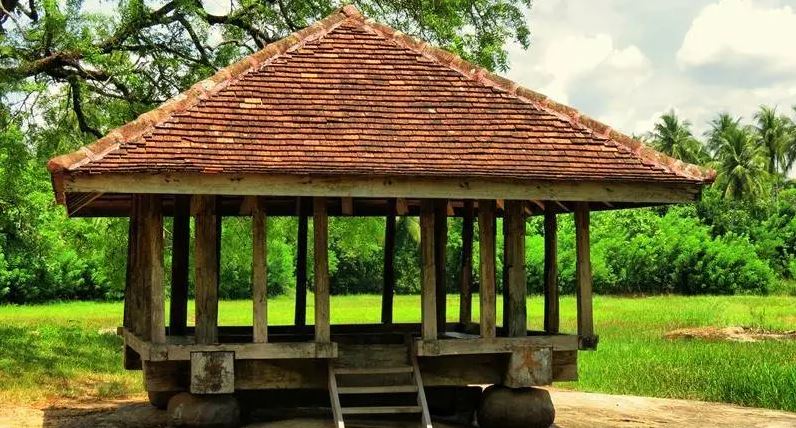
According to historical notes, the Panavitiya Ambalama was built in the 18th century. It is believed that it may have stood as a wayside shelter for travellers on the ancient footpath from Dambadeniya to Kurunegala and Yapahuwa. It is constructed on a wooden platform on four rounded large stones, one foot in height raised from the ground level to prevent damage from termite attacks. The roof is supported by 28 wooden pillars of which nine inner wooden pillars, six inches in height, display ornate carvings and motifs. The nineteen pillars that formed the outer posts were less elaborately carved. One of the striking features of the Panavitiya Ambalama is a wooden pillar with a carving of entwined cobra hoods. This kind of wood carving is rare in Sri Lanka.
The Ambalama is famed for many finely carved pillars depicting majestic birds. Each pillar has its own carving. Besides the wildlife carvings, some pillars are carved with wrestling men, dancing women, musicians, acrobats, persons greeting each other and persons chanting. The Ambalama itself is the finest living example of Sri Lankan architecture and art showcased in wood. Almost every inch of the wooden structures is decorated with elaborate, intricate carvings on rafters and beam columns. Some of these wooden pillars have been renovated by the Department of Archaeology.
Elaborate carpentry work
The value of the Panavitiya Ambalama lies in its elaborate carpentry work of beams and pillars. When I entered the Ambalama and observed the carvings, it reminded me of my visit to the Embekke Devale several months ago. Some of the Ambalama’s carvings bear resemblance to the ones at the Embekke Devale at Davlagala in Kandy. Having observed the antiquity of the structure, we noticed that it has been repaired and reconstructed over the years. We understood that some of the wooden beams have been replaced in some places. Walking around the site, we found fragments of the small Kandyan Peti-ulu tiles at the site indicating that originally the roof was tiled with Peti-ulu. The Department of Archaeology has renovated and restored the roof, replacing it with modern tiles.
Visiting this enchanting Ambalama, present day visitors can get a unique experience of the glory of the Dambadeniya Kingdom and some of the delightful wooden masterpieces of artistic creations of wood carvers of the bygone era. SO
The Panavitiya Ambalama on four solid rock stones planted on the ground
142 Viewers