The Idea of a Civilization-state and its Influence on Indian and Chinese Foreign Policies
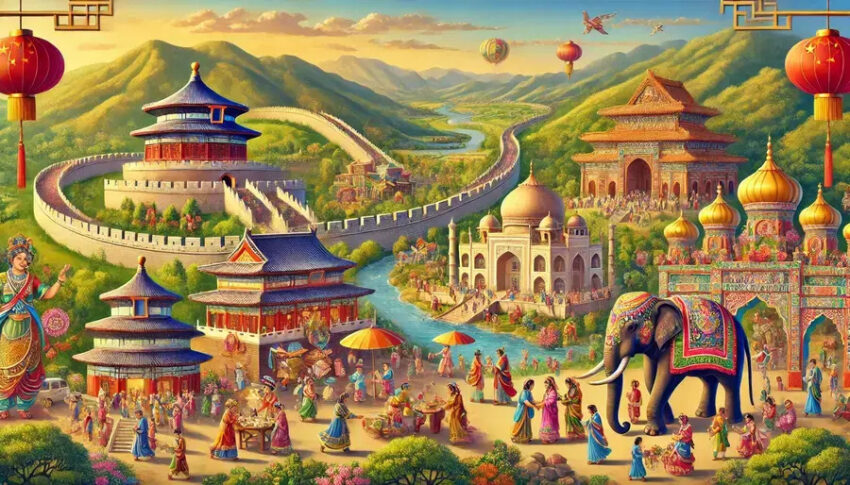
* In the 21st century; the rise in economic capabilities has led both China and India to showcase their civilizational heritage as an identity marker and as the centrepiece of their respective foreign policy discourses under Indian Prime Minister Narendra Modi and Chinese President Xi Jinping.
* Mao Zedong also embraced the imagination of civilizational spaces in making territorial claims for the Chinese nation-state.
* Xi Jinping proposed the ‘China dream’ that defines the Chinese nation as the manifestation of the Chinese nation and urged China’s population to work to continue and develop China’s civilizational values.
* Modi’s civilization–state-based foreign policy approach can be categorized into three distinct themes; privileging cultural-civilizational narratives in diplomatic outreach, India’s connectivity projects based on ancient trade and cultural ties, and more active outreach to the Indian diaspora.
📚 The Westphalian concept of the nation-state often leads scholars and students of international relations to utilise Western International Relations theories such as realism and neo-realism to analyse India and China’s approach towards foreign policy. A limitation of this Western-centric approach is that it is based on the assumption that India and China are driven only by material factors like other states in the Westphalian international system often ignoring the strong Civilizational aspect which drives the conduct of their foreign policy.
Concept of Civilization and Civilization-state
The term civilisation may be used in International Relations literature to represent ‘transnational, inter-human, and de-territorialized cultural communities’. These cultural communities are like imagined communities such as nation-states however unlike territorially bound nation-states civilizations span a much larger geographical and social expanse.
The concept of the nation-state is a relatively new concept that emerged in the 17th century when the 1648 Treaties of Westphalia ended the Thirty Years’ War in Europe by carving nation-states out of a warring Europe. Thus, the European concept of a nation refers “to a community of people which has one language, one religion (Catholic Christianity or Protestant Christianity) and one race “. When this community of people has one language, one community or one race when they form a nation with a government representing that nation it is called a nation-state. Thus, the concept of a civilization pre-dates the concept of the nation-state. A civilization state is a state that is both a nation and a civilization that considers itself to be the successor and inheritor of past civilizational heritage and glory whose influence is not necessarily confined to territorially defined limits of the Westphalian concept of a nation-state.
The Evolution of the Civilizational-state Discourse in India and China’s Foreign Policy
In the Post Second World War period, despite inheriting nation-states based on the Western Westphalian model and despite their radical plans for social reform and modernization when it came to state building both the Indian and Chinese political elite believed that they were inheritors of glorious and ancient civilizations. In their struggle to establish a socialist system in China, the Chinese Communist Party (CCP) expressed disdain for China’s cultural and civilizational legacies. Mao Zedong proclaimed anti-imperialism and anti–feudalism as the bedrock of Chinese nationalism and decreed socialist ideology and continuous revolution as the defining features of China’s national identity. However, Mao embraced certain civilizational and cultural aspects of China’s past to legitimize the CCP’s rule.
64 Viewers