IN MEMORY OF SRI LANKAN HERO LATE LT GEN DENZIL KOBBEKADWA- DEATH ANNIVERSARY
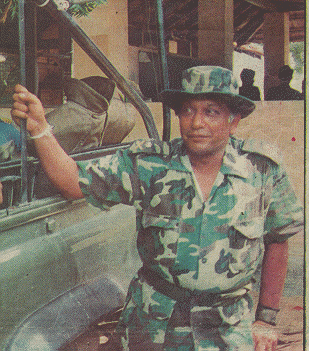
A hero is a great warrior or man of noble qualities and great achievements. Lieutenant General Denzil Lakshman Kobbekaduwa was both of these. He was beloved by his men, respected by his colleagues and loved by the people. Unfortunately, the powers that be, not being men of great stature would not give him his due not only when he was alive but even after he died.
Born into a wealthy family on 27 July 1940, the second child but the eldest of three sons, he was educated at Trinity College, Kandy. At school he excelled in sports, especially Rugby football, playing as scrum half. An exciting player, he continued to excel at this game even after he had joined the army. He not only played rugby football, he also coached, refereed and administered the game and was a Board member of the Duncan White Sports Foundation.
Lt. General Kobbekaduwa joined the army in May 1960 and received his training at the renowned military training institution, the Royal Military Academy, Sandhurst in England. Although the Sri Lanka army was more a parade ground army at that time, Lt. General Kobbekaduwa was to see it turned into a well trained, battle hardened and disciplined army of which he was the proud leader. Being a cheerful, energetic, efficient officer, Lt. Kobbekaduwa (as he was at that time) was well liked both by his superiors and his peers (and later his subordinates as well) and his promotions within the army came swiftly, despite twice being a victim of political interdictions in 1965 and 1977. He was promoted to Major General in 1990 and was posthumously promoted to Lt. General in 1992.
Lt. General Kobbekaduwa was not a mere soldier, he was a tactician. The training on the rugby field stood him in good stead in the battle field, the attacks he planned having the same precision of execution as had his attacks at rugger.
One of the most famous victories executed by Lt. General Kobbekaduwa was the manner in which he broke the siege of Elephant Pass. The attack on the army camp at Elephant Pass which was launched in July 1991 was planned by Prabhakaran himself who named it “Operation Charles Anthony”. Charles Anthony, alias Seelan had been Prabhakaran’s closest ally and it was in retaliation for his death that the landmine which killed 13 young soldiers was set off in July 1983.
 Prabhakaran even came out of hiding to visit the terrorists’ forward areas prior to launching the attack. Civilians were co-opted to man supply lines and hospitals and provide other services with all available transport being requisitioned and hundreds of coffins being stockpiled in readiness for the operation. The attack was launched with about 3000 personnel (men and women drawn from the North and East) but at the height of the battle this number rose to about 6000. The LTTE leader was willing to sacrifice anyone to win this location while he directed the attack himself from his hideout in Chavakachcheri.
The tactics used by Lt. General Kobbekaduwa in breaking this siege were unprecedented in the annals of Sri Lankan military history. Though the battle plans for Operation Balavegaya one was drawn up at the Joint Operations headquarters in Colombo the execution of these plans was in the hands of Lt. General Kobbekaduwa, which he did in his own inimitable style.
With no tanks and heavy armour, 8000 men were deployed for the rescue mission to relieve the besieged camp and regain territory captured by the terrorists. This was an amphibious operation backed with helicopters carrying troops, and was carried out against great odds and at enormous risk. Lt. General Kobbekaduwa was in the landing craft leading his men from the front, willing to take the same risks as his men.
The resistance put up by the terrorists with their blazing mortars and RPGs was so intense that some battalion commanders were considering aborting the operation temporarily. Lt. General Kobbekaduwa wanted to go ahead. In this he was supported by Brigadier Vijaya Wimalaratne, who died in the same bomb blast Araly Point. Despite heavy enemy firepower, the taskforce established a beachhead at Vettilaikerny and military history was made.
Denzil Kobbekaduwa has been called an “exceptional Third World General”. This is not to denigrate him but shows how good he was at carrying out a campaign under third world situations, where funds were limited and every resource had to be carefully nursed. It was Kobbekaduwa who in 1985 waged war with the LTTE on two fronts.
The LTTE found to their cost that sometimes the tactics used in the army operations against them were so sophisticated that many times the LTTE military strength was dispersed and their supply lines were disrupted and cut off. The superior fire power on which the LTTE depended to win battles were no match for these tactics.
The Adampan operation is one such instance. Here the armed forces waged a two prong attack one in the south-eastern entrance of Madhu Adampan base region while the main thrust was in the north western sector. It was only later the LTTE realised that while their forces were engaged the army had interdicted their supply lines in the area where the Mannar coast was linked to the jungle base of the Wanni. The planning was by Kobbekaduwa who could obtain maximum advantage from minimum resources a true attribute of great military leader. Even the LTTE fighters respected Kobbekaduwa’s strategical skills and military tactics that whenever such signs were observed in a manoeuvre, they associated it with him.
He was a professional and humane soldier with enough confidence in his skills to ask “Why should we let anyone else fight our war?” The IPKF, unhappy with his presence at the front, complained twice. His sense of justice made him realise that although the Tiger Terrorists were all Tamil, this did not necessarily mean that all Tamils were terrorists. He wanted to win the confidence of the civilian population, who, in this conflict, were caught between the devil and the deep blue sea as it were, and make them realise that they were better off trusting the army.
The most important trait in his character however, was his innate sense of fair play and justice. He never considered the civilian population of Jaffna the enemy. They were the victims of a ruthless terrorism, which they were helpless to overthrow. He and his men would do it on their behalf. He realised too, that the only way in which the terrorists could be weakened was to have the civilian population lose their fear and turn away from the LTTE.
He was fighting an enemy who had a large stock of arms and an advanced military infrastructure with limited manpower and finances and a mono-ethnic army. This made it difficult to hold on to territory, subjugating the people of the area to a military rule while continuing to wage war against a guerrilla army.
He used three principles in his counter-insurgency war measures: firstly, he did not believe in holding down land, secondly, he believed in drawing the enemy away from populated areas to minimise civilian deaths and with advance manoeuvring and superior fire power strain and destroy the enemy fire power, and thirdly make the civilians realise that they were better off trusting the armed forces. In fact, the UNHCR paid a tribute to him for his humanitarian approach to the beleaguered Tamil population.
It was six years ago on Saturday, the 8th of August that this brilliant tactician, this humane warrior, this hero, was lost to the nation. He was the man the nation had come to trust, had come to believe would lead the country to a lasting peace.
Lt. General Kobbekaduwa together with Major General Vijaya Wimalaratne and Rear Admiral Mohan Jayamaha, had been conferring far into the night on August 7th. They were planning an operation which was to be launched shortly. The final decision was delayed until they could reconnoitre a particular area to finalise troop movements, which required a visit to Araly point the next day. It was while they were returning to be taken back to the base by helicopter that the tragedy occurred.
An explosion was heard by two majors who were watching the jeep in which the three military leaders were travelling. Majors Rupasinghe and Induruwa were 400 yards away from the jeep. When they came running up, they found that except for two persons, the others, whose bodies were mutilated, had died instantaneously.
The intact bodies of Lt. General Kobbekaduwa and Rear Admiral Jayamaha were loaded onto the waiting helicopter which took off immediately to Palaly where the Rear Admiral was found to be dead. Though he was mortally wounded, Kobbekaduwa had said “I’m all right, see what can be done to the others..” As the doctors were unable to do more for him at Palaly, Lt. General Kobbekaduwa was brought to Colombo where a team of leading specialists battled to save his life, but were unsuccessful.
Lt. General Kobbekaduwa had remarked once that he wanted to die in his boots. Perhaps he had a premonition about the manner of his death. With him the hopes of a nation seemed to die. Since then the war has continued for six long years. Yet, his legacy lives on. The men who were trained by him, now follow in his footsteps and slowly but surely are taking the trail he blazed.
1191 Viewers