The letter that New York Times refused to publish
 Noam Chomsky, the left-wing critic of America, pointed out that the Western media falls in line with the foreign policy of the US State Department. Even the prestigious New York Times is no exception.
For instance, Atul Keshap, Deputy Assistant Secretary for South Asia, Bureau of South and Central Asian Affairs, popped in for three days and told the Sri Lankan media that Sri Lanka is the only country that has joined N. Korea and Syria in rejecting UN resolutions. This is factually incorrect. US and Israel have been among the nations that had rejected UN decisions. This was pointed out by me in July when Keshap made this statement which is mile away from the truth. Not surprisingly The New York Times, following the US State Department lies, has repeated it in its editorial attacking Sri Lanka in August.
The New York Times has the right to back any policy it wants. But it should not do so with lies. Besides, when its errors are pointed out it should have the decency to correct them.
The New York Times has sailed under the well-known slogan of: “All the News that’s fit to print”. Not surprisingly, when it’s distortions are pointed out it is not considered news fit to print. The following letter was sent in response to its misleading editorial. Needless to say it was not published.
Dear Sir /Madam,
The picture of “Sri Lanka’s Intransigence”, painted in your editorial (22/8/2104) would have been complete if the following historical facts were added to it:
 1. NYT: Sri Lanka is in the company of North Korea and Syria that had barred access to UN investigators. The omission of Israel in this category is significant. When UNHRC appointed Richard Falk to investigate the violations of human rights in Palestine territories Israel barred him from entering. US defended and endorsed it.
2. NYT: “It was the Sri Lankan government’s failure over several years to prosecute and punish perpetrators of abuses during the civil war that prompted the United Nations Human Rights Council in March to request a comprehensive investigation.” It didn’t take “several years (for the UNHRC) to prosecute and punish” Sri Lanka. UNHRC first moved against Sri Lanka within a week of war ending in May 2009 without any official report/study/analysis to back its anti-Sri Lankan move. This was defeated roundly and a counter resolution was passed by UNHRC commending Sri Lanka for ending the war with the least amount of casualties. But the UNHRC relentlessly pursued Sri Lanka until the US-led resolution was finally passed in 2014.
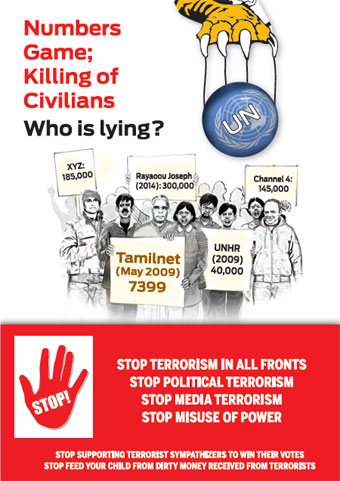
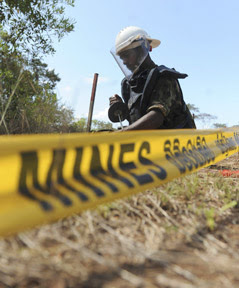
3. NYT: Hundreds of thousands of people interned under military guard and 40,000 killed in the final weeks of the war. Fact: 300,000 Tamils held as hostage had nowhere to go when the Army launched the rescue operation. These IDPs were given shelter, food, and medicine in hastily established camps jointly with India. Indian and Sri Lankan doctors worked 24 hours offering their services and expertise. The IDPs were released once the mined land was made safe for them to settle down. Security Forces personnel engaged in de-mining activities
 4. As stated in your editorial Ms. Navy Pillay, the United Nations high commissioner for human rights, has said
that she “would go forward despite Mr. Rajapaksa’s denial of access.” Her exercise would lack credibility because it is a remote controlled investigation opposed by India and the Asian neighbours who had refused entry visas to the UN investigators. Besides, the Government of Sri Lanka has demonstrated its ability and the willingness to conduct its own investigations with the assistance of international experts. So which one will have the credibility: the remote controlled one or the home-grown one?
5. Finally, to single out Sri Lanka as one of those member states not complying with UN decisions does not confirm the historical facts. One of the fundamental flaws of the UN system is the failure of member states to comply with UN decisions made at various levels, ranging from Security Council and UNHRC to ICJ. US, for instance, refused to implement the judgment of the ICJ on Nicaragua. US even refused to be a member of UNHRC until recently. Highlighting US’s latest move, Jerusalem Post (18/8/2014) reported: “The US and other western powers have exerted pressure on the International Criminal Court at the Hague to prevent a war crimes probe of Israel’s operation in the Gaza Strip, The Guardian reported on Monday, quoting former court officials.
Yours sincerely,
H. L. D. Mahindapala
Editor, The Observer (1990 -1994)
President, Sri Lanka Working Journalists’ Association (1991 – 1992)
Secretary-General, South Asia Media Association (1993 -1994)
Address: 53, Galahad Crescent, Glen Waverley, Vic. 3150, Australia
981 Viewers