Good for the Indian Goose, not good for the Sri Lankan Gander
(Courtesy of The Island)
by Rajeewa Jayaweera
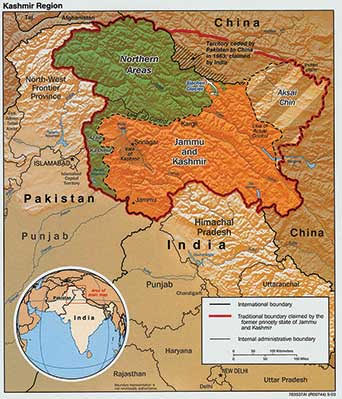 One of the most contentious aspects in Indo – Pak relations since independence has been the Kashmir issue. Kashmir was a majority Muslim state governed by a Hindu ruler at time of independence and joined the Indian Union under questionable circumstances. India and Pakistan have gone to war over Kashmir on several occasions.
The Kashmiris mounted an armed struggle for the Right to self-Determination which turned into an insurgency during 1980s and early 1990s. It was put down by India using its armed forces and draconian laws and statutes such as Terrorist and Disruptive Activities (TADA), Jammu & Kashmir Public Safety Act 1978, The Armed Forces Special Powers Act 1990 (AFSPA), Jammu & Kashmir Disturbed Area Act 1990 and Prevention of Terrorism Act (POTA) 2002. AFSPA protects members of security forces from prosecution for alleged Human Rights abuses and empower security forces to search, detain and use lethal force against any person acting against the law.
On March 9, 1993, 26 political, social and religious organizations formed an alliance under the banner All Parties Hurriyat Conference (APHC) to further their objectives. Pakistan has been supportive of the APHC as they share common views on Indian controlled Kashmir (Jammu & Kashmir). Internal conflicts amongst Hurriyat Conference leaders led to an initial split within the alliance in September 2003 and a further split in 2004. The two camps are led by hardliner Syed Ali Shah Geelani and moderate Mirwaiz Umar Farooq.
Even though India had consistently objected to leaders of the Hurriyat Conference meeting with Pakistani leaders and state officials, meetings have taken place from time to time. India had repeatedly termed Pakistan’s meetings with APHC Representatives not ‘appropriate’. In August 2014, scheduled discussions between Indian and Pakistani Foreign Secretaries were called off by India stating “talk to the separatists or talk to us” after the Pakistan High Commissioner in Delhi held a meeting with APHC leaders. A similar incident occurred in August 2015 which led to the last minute cancellation of a round of talks between the National Security Advisors of the two countries. India placed APHC leaders under house arrest in Srinagar to prevent them from travelling to Delhi to meet Pakistani officials. India was severely criticized for this act in many quarters from both within and without. The meeting finally took place in Bangkok between the two National Security Advisors. It has been followed with discreet communications and thawing of relations. India seems to have finally realized the absurdity of its previously held policy of “either talk to the separatists or talk to us”. As a result, Pakistan Day celebrations a few weeks ago saw a high powered delegation of APHC leaders in attendance.
Despite numerous setbacks, Foreign Secretaries of both countries finally met in New Delhi on 26 April. Whereas India raised the issues of 26/11 Mumbai attack trial and the Pathankot attack, Pakistan raised the Jammu & Kashmir issue. The fact that the two Asian nuclear powers are talking to each other after years of posturing and sabre rattling is a matter of relief to the smaller countries in the region.
Latest news from Delhi now indicates a volte-face by India. On 28 April, Indian minister of state for external affairs, VK Singh in a written response tabled in the Indian Parliament stated “Since the entire state of Jammu and Kashmir is an integral part of the Union of India and these so-called Kashmiri ‘leaders’ are Indian citizens, there is no bar on their meeting with representatives of any country in India”. He has further stated “India has consistently maintained there is no role for a third party in the bilateral dialog between India and Pakistan as per Simla Agreement and the Lahore Declaration. India’s displeasure at Pakistan’s attempts to interfere in India’s internal affairs has been repeatedly conveyed to Pakistan”.
Firstly, India for 23 years vehemently objected to APHC leaders who they termed as ‘separatists’, meeting with Pakistani leaders and officials. On the other hand, India saw it fit to continuously meet and deal with Tamil terrorists from the late 1970s till their annihilation in 2009 which included aiding, abetting, training and arming Tamil separatists (terrorists) for a considerable period, till the separatists turned on India.
Secondly, India will not agree to discuss the issue of the Right to Self Determination for the people of Jammu and Kashmir with Pakistan. It has repeatedly ignored the non-binding UN Security Council Resolutions No 47 of 1948 and 91 of 30 March 1951. However, India continues to involve itself in Sri Lanka’s national question without leaving it to GoSL and leaders of the Tamil community to resolve their issues.
India force-fed Sri Lanka with the 13th Amendment to its constitution in 1987. It was and still is India’s policy to meddle in Sri Lanka’s national issue involving the Tamil community.
India justifies its involvement in Sri Lanka’s national question on behalf of Sri Lanka’s three million Tamil population (15.4%) based on fears of a backlash from its own Tamil population of 65 million in Tamil Nadu (6.1%), separated from Sri Lanka by the Palk Straits. The same justification is not applied when it involves 8.5 million Muslims in Jammu & Kashmir (68%) receiving aid and support from Pakistan, a country with a population of 191 million, 97% of which are Muslims and a common land border to boot.
In all these developments, there are lessons to be learnt for Sri Lanka. Despite the thinly veiled acts of friendship extended by India since 09 January 2015, its current policy can at best be described as “positive unilateralism”.
Whereas India has been unable to have its way with Pakistan, another nuclear power, it has had its way, all the way, with Sri Lanka, a small and hapless nation due to sheer size and numbers which gives it unbridled economic and fire power. India would never have accepted a Sri Lankan assertion of “either talk to the separatists or talk to us”. It would have ignored a Sri Lankan stand of meetings between Indian officials and Tamil terrorists (at times, almost daily) as not ‘appropriate’. Expressions of Sri Lanka’s displeasure at India’s interference in its internal affairs would have fallen on deaf ears similar to the current poaching issue. India would also not respect a Sri Lankan stand point of “there is no role for any third party in Sri Lanka’s national question”.
There is no dispute of the need for Sri Lanka to maintain cordial and friendly relations with India. Special consideration is required on the part of Sri Lanka for India’s security concerns in its southern sea board. There is no other way simply for the lack of any other choice. However, such a policy need be followed by our leaders and those who propagate close ties with India for commercial considerations, bearing in mind India will single-mindedly follow a policy of ‘self-interest first’ at any cost, as outlined in the two given examples. Catch phrases such as ‘the land that gave us Buddhism’ have no place in such a narrative.
724 Viewers