Pioneer in Buddhist Revival Movement
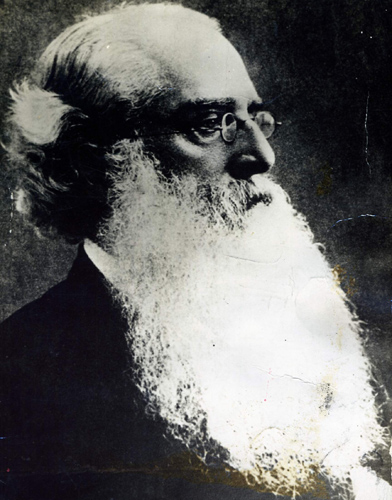 (Courtesy of Daily News)
Colonel Olcott was an inspiring servant of mankind. He lived in our age and dedicated the later years of his life to Buddhism and the peoples of Asia particularly those of India and Sri Lanka. He gave up an affluent life for a simpler and nobler one. He devoted his energies to working for the benefit of the common people. The services rendered to Asia and particularly to the revival of Buddhist cultures are contributions worthy of an honoured place in the pages of Asian history.
Colonel Olcott died on February 17, 1907, at his home in Adyar, near Madras India, after having served his beloved Asian people for nearly 32 years. The anniversary of his death is celebrated throughout India and particularly by the people of Sri Lanka, who have a special veneration for him.
Colonel Henry Steele Olcott was born on August 2, 1832, in Orange, New Jersey, U.S.A. After a brilliant school career at the City College of New York and Colombia University, he became interested in agriculture. He edited a farmers’ periodical, and in 1858 he became associated with the New York Tribune as the agriculture editor. When the American Civil War broke out in 1861, he gave up his newspaper work and went to the front, where he eventually attained the rank of Colonel. Colonel Olcott served in special capacities in both the Army and Navy Departments.
After the conclusion of the war, he was admitted to the Bar of New York State. He became a prominent as a lawyer, as well as an investigator of “graft” especially in connections with the scandals in the Mustering and Disbanding Departments. This work required unusual integrity and courage, as his life was constantly threatened.
Christian Orthodoxy
When he was employed by the New York Sun to investigate the mystic phenomena which took place at the Eddy Farm in New York, where he met Madame Blavatsky and he began a long friendship and collaboration with her which lasted until her death in 1891. During this time Colonel Olcott became interested in oriental religious, especially Buddhism. In 1875, he and Madame Blavatsky founded the Theosophical Society of New York. The main objective of the Society were to establish the nucleus of a universal brotherhood of humanity, to promote the study of comparative religion and philosophy and to make a systematic investigation of the mystic potencies of life and matter, or what is usually called occultism.
He sat out with Madame Blavatsky for India in 1878 to study various religions there, and they arrived in Sri Lanka on May 17, 1880. Sometimes later in the same month both of them embraced Buddhism publicly in Galle. What profounded influenced Colonel Olcott to adopt Buddhism as his religion was his study of the famous public debates that took place in 1873 at Panadura. These debates erupted between incumbent monk Ven. Migettuwatte Gunananda of Kotahena Temple, and his adversaries in the Christian priesthood. It is recorded by a bhikku that Ven. Gunananda faced the united forces of Christian Orthodoxy. So, powerful was his eloquence and reasoning in the Panadura Controversy, which was intended to bring discredit to the Buddhists, that the tables were turned against Christianity in Sri Lanka.
The decades between 1870 and 1890 became a crucial period in the history of Sri Lanka. The four notables in this period were Ven. Migettuwatte Gunananda, Ven. Hikkaduwe Sri Sumangala Maha Nayake Thera of Maligakanda Vidyodaya Pirivena, Colonel Olcott and his pupil, the Ven. Anagarika Dharmapala. Their contributions to revival of Buddhism, Buddhist Culture and Buddhist education will never be forgotten by the Sinhalese Buddhists, who revere their memory.
When Colonel Olcott came to Sri Lanka in 1880, this great civilization was in a decadent state. He found on his arrival that there were only three Buddhist schools in this Buddhist country. The education system was dominated and dictated by the Christians churches, which discriminated against the Buddhists and compelled them not only to go to Christian schools, but also to get marriage certificates only in Christian Churches.
It was a time when Buddhists were frightened and ashamed to call themselves Buddhists openly, due to fear of economic persecution by the missionaries. Colonel Olcott revolted against this prejudice and therefore he started Buddhist educational movement and founded the Colombo brand of the Buddhist Theosophical Society, with the cooperation of Buddhists. In a remarkable way, all the high Buddhist monks of the island gathered around and received him with much warmth, so that he was the envy of other Europeans who lived secluded and isolated from the native people. He became one of the oppressed Buddhists who fought for their rights.
Colonel Olcott, together with Anagarika Dharmapala, were pioneers in the Buddhist revival movement in India and Sri Lanka. They worked together in the development of Sri Lanka’s educational movement. They travelled from village to village on foot and in bullock cart, exhorting the people to live Buddhist lives, and collecting funds. Principally to the credit of Colonel Olcott there are about, 12 large colleges and over 400 Buddhist schools in the island.
International Buddhist flag
At this point Colonel Olcott felt the need for a symbol to rally the local Buddhists. To meet this need, he designed a flag for the Buddhists from the aura that shone around the head of the Buddha. It was accepted as the International Buddhist flag by the World Fellowship of Buddhist which met in Sri Lanka in 1950 for the first time, and its acceptance was further confirmed at the conference in Japan in 1952.
On the full moon day of Vesak in 1881, Olcott inaugurated at Kelaniya Temple a Buddhist National Fund for the “general promotion of religious and secular education of Buddhist literature”. The first cheque Rs. 100 was handed to Olcott immediately after his speech by R.A. Mirando. By 1886 the Buddhist National Fund had collected Rs. 13,000. Olcott also did many things to rouse the people’s enthusiasm and he suggested the necessity for a public holiday on Vesak day and helped in getting if for the Buddhists.
On February 13, 1881, the first Buddhist Sunday School was started at the Society’s premises in Maliban Street. C.W. Leadbeater, who had come to Sri Lanka with Olcott, was in charge of the Sunday School. On November 1, 1886, the same school in the Pettah was converted into the Pettah Buddhist English School, which later became Ananda College. The school started with 37 pupils with Leadbeater as honouary Head Master.
Before Olcott said goodbye to Sri Lanka he was able to see the fulfillment of the hopes he had on the eve of his first landing on these shores. In his achievements the sphere of education is the brightest. There were, when he left Sri Lanka a number of Buddhist Colleges and hundreds of schools to credit of his movement.
Olcott’s last message
– February 2, 1907
“To my beloved brethren in the physical body, I bid you farewell. In memory of me, carry on the grand work of proclaiming and living the brotherhood of religions”.
“To my beloved brothers on the higher planes, I greet you and come to you, and implore you to help me to impress on all men on earth that there is no religion higher than truth, as the Buddhist say and that in the brotherhood of religions lie the peace and progress of humanity.”
(A special ceremony was held yesterday to mark Col. Henry Steele Olcott Day at the Kularatne Hall under the patronage of Senior Old Anandians of Ananda College)

793 Viewers