Tampita vihara -historic religious buildings on beams
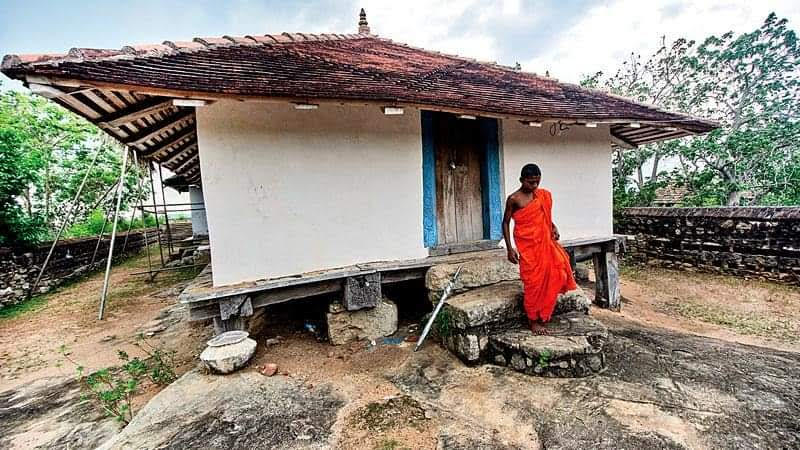
There was a unique type of Vihara called the ‘Tampita Vihara’ during the Kandyan period. The Tampita Vihara is a temple on pillars. Its most prominent feature is that it is mounted on stone pillars or dwarfed rock pillars.
This type of Vihara that stood on raised platforms of wood standing on stone pillars or on huge rock boulders was constructed this way to prevent white ants or other vermin from entering and damaging it. The Panawitiya Ambalama has also been built using this method.
On a recent tour around the interior of Kurunegala not far from the city, it came to know that there are a few such Tampita Vihara in surrounding areas of Kurunegala. These archaic monuments are preserved by the Department of Archaeology.
If you travel North West of Kurunegala, 25 kilometres away lies the Bihalpola Tempita Viharaya, a unique Vihara that dates back centuries. It is just five kilometres down the Kuliyapitiya road from the Kadahapola junction on the Kurunegala-Madampe road. The superstructure of the Bihalpola Tampita Vihara is composed of wattle and daub and square in shape. There are three Viharas altogether which belong to different periods of time built on a huge rock boulder on the top of the hill, of which the relic chamber (Dhatu Mandiraya) is in the middle of the buildings.
The building at the far end of the temple complex is also a shrine room, decorated with murals, which houses the main image of Buddha that belongs to the Kandyan period. A dramatic architectural feature of this small building is that it is built on a framework of massive wooden beams that rest on elevated solid rocks placed on a rock boulder. Some wooden pillars have been driven into the rock boulder, in some places. The walls of the square Vihara are built with wattle and daub using lime plaster on surface. It also has a characteristic roof thatched with Kandyan Pet-Ulu (flat tiles).
113 Viewers