Yahapalana hegemony solidifies
(Courtesy of The Island)
Blunder of Yahapalanaya
 The attempt by the SLFP parliamentarians in the Joint Opposition to become an independent group in parliament came to naught with Speaker Karu Jayasuriya refusing to grant them that recognition. The excuse he gave was one of the lamest ever – that he cannot take the responsibility for having committed the crime of splitting the SLFP or the UNP. Jayasuriya himself led Sri Lanka’s biggest mass defection of MPs from the UNP to the UPFA in 2007 and he still holds the record in that respect. (The earlier record holder was S.B.Dissanayake who led a defection in the opposite direction from the PA into the UNP in 2001.) So for Jayasuriya to refuse to recognise a functioning independent group which has even voted against a budget seems to the Rajapaksa camp to be the height of hypocrisy.
The manner in which Karu Jayasuriya has conducted himself as Speaker has been very different to the way that his predecessors Chamal Rajapaksa, W.J.M.Lokubandara and Anura Bandaranaike conducted themselves. The Speaker in parliament is a key figure of the state who bears onerous responsibilities in safeguarding democracy. It is he who looks after the rights of the MPs elected to parliament. In past parliaments, there were many instances of MPs sitting independently. In the 2004-2010 parliament, the JVP had 39 MPs elected on the UPFA list and after a while they were sitting independently. In the same parliament Ven. Uduwe Dhammaloka elected on the JHU ticket was sitting independently almost from the beginning. Then JVP parliamentarian Nandana Gunatilleke sat independently of the JVP group which itself was already sitting independently of the UPFA.
This freedom is important in safeguarding democracy in the country, and the Speaker has a major role to play in this by ensuring the freedom of the representatives of the people. But Karu Jayasuriya has flouted all the principles that his predecessors upheld. To tell the SLFP members of the Joint Opposition which votes against the government and speaks against the government in parliament to get the concurrence of Nimal Siripala de Silva, a cabinet minister in the government, for them to function as a separate group is not something that any self respecting Speaker would have done. One would think that the first duty of the Speaker would be to give due recognition to the divisions within parliament and see that everyone enjoyed their rights. All the SLFP members in parliament were elected on an anti-UNP, anti-government platform and that alone provides justification for members of the Joint Opposition to want to function as a separate group from the SLFP members who have joined the government.
The same alliance that got together to bring President Maithripala Sirisena into power now controls both the government and the opposition. The TNA and the JVP which were both integral parts of the yahapalana alliance have divided up the important slots in the opposition among themselves. The same yahapalana partners have divided up the slots in the Constitutional Council among themselves and as a result, all the appointees to the supposedly independent police, public service and other commissions are also all yahapalana acolytes. This country has never seen a political hegemony like this. At the last parliamentary election, despite all that President Sirisena did to buckle the UPFA election campaign, there was only a marginal difference between the victorious UNP and the defeated UPFA. This large mass of people have been denied due representation in parliament due to the actions of the Speaker.
Zeid Al Hussein blows hot and cold in Colombo
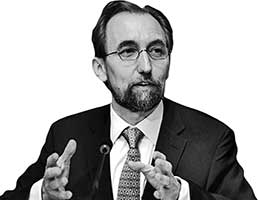
Concluding his four day visit to Sri Lanka, UN Human Rights Commissioner Zeid Al Hussein held a press conference at the UN office in Colombo last Tuesday. There was a great deal of interest in this Press Conference as the new UN Human Rights Commissioner had adopted a very aggressive attitude earlier in presenting to the UN Human Rights Council the report written by his office, the OHCHR, alleging that war crimes had been committed in Sri Lanka and asking for the institution of a hybrid war crimes court in this country. The 15 minute speech he made to the UNHRC on that occasion was just as aggressive and as judgmental as any speech delivered by his predecessor Navaneetham Pillai. Most of the journalists who went to the UN office in Colombo last Tuesday were probably expecting another speech of the same sort.
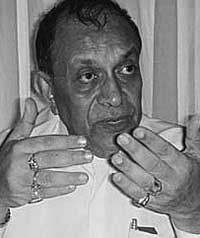 The press conference started off at 3.00 pm and featured a 20 minute speech by Hussein followed by a brief Q and A session. The speech stating the official position of the UN Human Rights Commissioner after his visit is what is most important, not what he says in response to questions posed by journalists. It is his statement that gets into the UN records as the official position taken by the HR Commissioner. His speech in Colombo came as a surprise to most of us who had heard Hussein speaking in the UNHRC in September last year. In contrast to his earlier speech which was aggressive and full of criticism, his speech after his visit to Sri Lanka was different in both tone and content. It was very clear that someone had given him clear instructions to say whatever he is going to say without setting Colombo on fire and destabilizing the government.
Hussein’s speech was so carefully crafted that even those of us who were sitting right in front of him were left with the impression that he had not said anything significant and that he had manoeuvred around contentious issues without taking them head on. The first impression that I had of his speech was that there was nothing worthwhile to report back to the newspaper. At question time, Zeid Al Hussein seemed even more flexible and at the end of the whole process, it seemed as if he had completely changed his earlier position.
However given the manner in which the UN works, I went back and listened to the recording of Hussein’s official statement yet again. And sure enough there was his earlier position on Sri Lanka stated plainly but deliberately concealed amidst a whole lot of distracting verbiage. From our recent experience we have found out that when it comes to UN documents you must never read whole paragraphs but one sentence at a time. When read in that manner, Hussein’s statement revealed his true stand.
Every journalist in the hall was waiting to hear from the High Commissioner what commitment the government had given him concerning the implementation of the highly controversial UN Human Rights Council resolution passed last year. In relation to this Hussein said in his speech that he had met President Maithripala Sirisena and Prime Minister Ranil Wickremesinghe that morning and that they had both assured him that Sri Lanka will be meeting its human rights commitments. The UN Human Rights Commissioner said that the President and Prime Minister had given him this assurance when he had informed them of the fears expressed by victims in the North and East that the government may be ‘wavering in its human rights commitments’.
High Commissioner Hussein minced no words in his criticism of Sri Lanka’s judiciary saying that Sri Lanka’s key institutions had been ‘corroded and corrupted’ during three decades of conflict and that though Sri Lanka has many excellent judges, lawyers and law enforcement officials, over the years the system they depended upon became highly politicized and unbalanced and unreliable. The country’s history is ‘littered with judicial failures’ he said. “Virtually every week provides a news story about a failed investigation, a mob storming a court room or another example of a crime going unpunished” he said, and stressed that it was for these reasons that the OHCHR report on Sri Lanka and the UN Human Rights Council suggests international participation in the accountability mechanisms that are to be set up to deal with international crimes and gross human rights violations.
Hussein further stressed the importance of the recommendations made in the UNHRC resolution and wanted everyone to remember that the UNHRC resolution was co-sponsored by Sri Lanka and passed with the concurrence of all 47 member states of the UNHRC. He stated that the UNHRC resolution pointed out an “An eminently sensible pathway for the country to follow”. He said that his office was charged with following up its implementation. The High Commissioner also said that the international community wants the armed forces to face up to the stain on its reputation. He warned against neglecting or mishandling any of the four key elements of post conflict resolution – truth telling, accountability, reparations and institutional reform lest this country lose a major opportunity to establish long term stability.
Hussein also said that large parts of the country had been physically, politically, socially and economically separated from each other for the better part of the last three decades and that while Colombo is a bustling city with a mass of construction sites, flourishing businesses and clean streets, in the North and East there are damaged and depressed areas where poverty is rife. While there are some signs of physical development and positive vision (in the North and East), there are ‘ominous signs of hopes not yet bearing fruit and optimism showing signs of souring’. Hussein recommended the following immediate measures to halt the ‘draining of confidence’. (a)The military should accelerate the return of land it has ‘seized’ in the North and East (b) The government should reduce the number of military personnel in the North and East. (c) The govt. should find a formula to either charge or release the remaining Tamil detainees.
Thus, in a very unobtrusive way, Zeid Al Hussein has basically said everything that we journalists thought he would say. And this is what will go down as his official position in UN records. Hussein added that his visit was more friendly, cooperative and encouraging than the one his predecessor Navaneetham Pillai ‘endured’ in August 2013 which was marred by vituperative attacks on her integrity simply because she addressed a number of burning human rights issues which any High Commissioner for Human Rights would have raised at the time. For our part, too perhaps we must say that High Commissioner Hussein’s visit to Sri Lanka has not ruffled as much feathers as his predecessor’s visit. Even though Hussein said all that we thought he would say, it was not delivered in an abrasive manner.
Even though Hussein had unobtrusively stated his usual position in his speech, he adopted a much more conciliatory position during the question and answer session. So what are we to make of all this? If he was actually going to be conciliatory, it would have been much better to utter those conciliatory statements in his official speech itself. Whatever he says in response to questions posed by journalists may get reported here, but does not reflect an official position. No verbal assurance given by a UN official should ever be taken at face value. In any event, in answering the questions of journalists, Hussein used language which can later be turned in any direction. When UN General Secretary Ban Ki-moon established that ‘expert panel’ on Sri Lanka outside the established procedure of the UN, he had given the verbal assurance to President Mahinda Rajapaksa that this was only to advice him on Sri Lanka. But he published the report and distributed it to all other bodies of the UN such as the UNHRC and the General Assembly and acted as if this report was an official document of the UN even though it was nothing of the kind. The UN Secretary General can establish a ‘Panel of Experts’ to study the situation in a country only on the express instructions of the UN Security Council and there was nothing of the sort in Sri Lanka’s case.
The unreliability of UN officials is thus something that Sri Lanka has experienced directly. So the flexibility shown by Hussein in response to questions posed by journalists may be just a feint. Having found during his visit to Sri Lanka that public opinion is dead set against the implementation of the UNHRC resolution, it may be the case that Hussein has made a temporary retreat to fight another day. In any event, the following are the answers that he gave in response to questions posed by journalists.
Hussein’s Q & A session
Journalist: The government has not made a firm commitment with regard to the participation of foreign judges in the proposed judicial mechanism. When you visited the Ven. Mahanayake Theros they too expressed their opposition to a hybrid court and the participation of foreign judges. What is your response to this?
Hussein: When we put together the report on Sri Lanka, we thought foreign participation was necessary. The resolution adopted by the UNHRC has also used language which points in that direction. These are recommendations. But with Sri Lanka’s co-sponsorship of the resolution we expect acceptance, but that does not mean that there will not be variations in how it is implemented. I am under obligation to return to the Human Rights Council and inform the Council of progress in implementation. We will be in close contact with the Sri Lankan authorities to understand what their thinking on this matter is. In the end it is the sovereign right of Sri Lanka to make determinations in respect of its future.
Journalist: President Maithripala Sirisena told the BBC that there are no allegations of war crimes. What is your take on this?
Hussein: What we carried out was a human rights investigation. It was not a criminal investigation. The patterns of the abuses that we registered, suggested that further criminal investigations as to whether war crimes were committed was warranted. However, only a court can make the confirmation that war crimes were committed. Until then these are only allegations.
Journalist: The government says that recommendations are recommendations and that there is nothing to say that these recommendations MUST be implemented. Does the government have any discretion in this regard?
Hussein: It goes without saying that once you look at the details you realize that there is a public position on this matter which is normal. You might have adopted the council report but when you look through the material you begin to develop your own thinking on the matter. We have said that the suggestion of having an independent and impartial court is fundamental because it must address the needs of victims of all sides. We thought that by having international participation that can be guaranteed. The consultation process that the government has initiated in this regard is very important.
Journalist: The UK has rejected the findings of the UN Working Group on Arbitrary Detention on Julian Assanage. Certain countries use or reject the findings of UN bodies depending on their own preferences. Is the OHCHR being used for the foreign policy objectives of certain powers?
Hussein: The Office of the High Commissioner on Human Rights is not being used or exploited by any particular member state. We give opinions and comment on the human rights situations in all countries without exception.
Journalist: You spoke of a process of consultation initiated by the government. Does that indicate a certain flexibility on your part vis-a-vis the recommendations in the UNHRC resolution?
Hussein: You have the resolution which broadly outlines what the international community would like Sri Lanka to do. But as the details are worked out, these elements will find finer resolution.
Journalist (The Island): My question is in relation to the time that will be taken to address the various recommendations made in the UNHRC resolution. There is a resolution regarding Sri Lanka and the UNHRC has a resolution concerning your office, the OHCHR, as well. Year after year, the UNHRC has passed resolutions with something like a two thirds majority recommending that the preponderance of Westerners on your staff and the dependency of your office on funds from Western countries should be reduced. My question is whether the UNHRC will be satisfied if the resolution on Sri Lanka is implemented with the same speed that the OHCHR implements the UNHRC resolution concerning the composition of the OHCHR staff and sources of funding?
Hussein: That’s a very good question, I will answer that. It is true that we have a large number of Westerners in my office. Historically the Western countries have funded the OHCHR through extra-budgetary donations. But I don’t think it has any effect on the work of the office. I have commented on human rights violations in the North as well as the South. But yes, the issue you raise is something that we would like to address because the Human Rights Council has pointed it out and we do try to recruit people from other parts of the world. All of this requires a step by step approach. (High Commissioner Hussein did not really answer the question whether the UNHRC will be satisfied if SL implements the UNHRC resolution with the same speed that the OHCHR implements the UNHRC resolution against itself, because the OHCHR never seems to move a finger to implement the resolution demanding a reduction of Westerners serving on its staff or dependency on Western funds!)
Journalist: Don’t you think there is some lack of clarity on the part of the Sri Lankan government with regard to the participation of foreign judges?
Hussein: The preference of the Sri Lankan government on this matter has been made known. We know that they are looking at various options within what they have defined as their preference. What we say from our side is that it is your sovereign right to make these decisions, but in the end all that you do will be for naught unless the victims feel that justice is being done.
We see thus that the UN Human Rights Commissioner has stated his usual position in his official statement at the end of his visit to Sri Lanka albeit in a non-aggressive and non-abrasive way. But he has shown much greater flexibility in his position in answering the questions of journalists. The reason for this flexibility is obviously because of the difficulties in implementing the UNHRC resolution that he would have been made aware of during his time here. The Mahanayake of the Malwatte Chapter told him point blank that a hybrid court with foreign judges would be unacceptable. When he went to see the Mahanayake of Asgiriya his staff hustled all the journalists out and shut the door obviously for fear of what the Ven Mahanayake will say.
The journalists present for their part realized too late that they had been thrown out by the UN staff and not the Ven. Mahanayake. By the time they gathered their wits about them, the door had already been shut. One irate journalist was heard commenting “This is the Ven Mahanayake’s premises. How can the visitors throw us out without even asking the Mahanayake hamuduruwo?” This episode showed that Hussein was really running the gauntlet while he was here and that was without him meeting any of the groups actually opposed to the government. The flexibility that he showed at the end of his visit was obviously due to the opposition to the UNHRC resolution that he would have been made aware of at every turn.
This awareness on the part of the UN Human Rights Commissioner provides a window of opportunity for the government to put right the blunder they made last year in not negotiating with the Americans for more favourable terms in the UNHRC resolution. At the stage the resolution was being discussed, the government did have a window of opportunity to get some radical changes made in the resolution with the help of their American allies so that they could have returned to Colombo in triumph and claimed it as one of the benefits of having the yahapalana government in power. But they botched that opportunity. Will the same happen to the window of opportunity that has opened up again?
864 Viewers