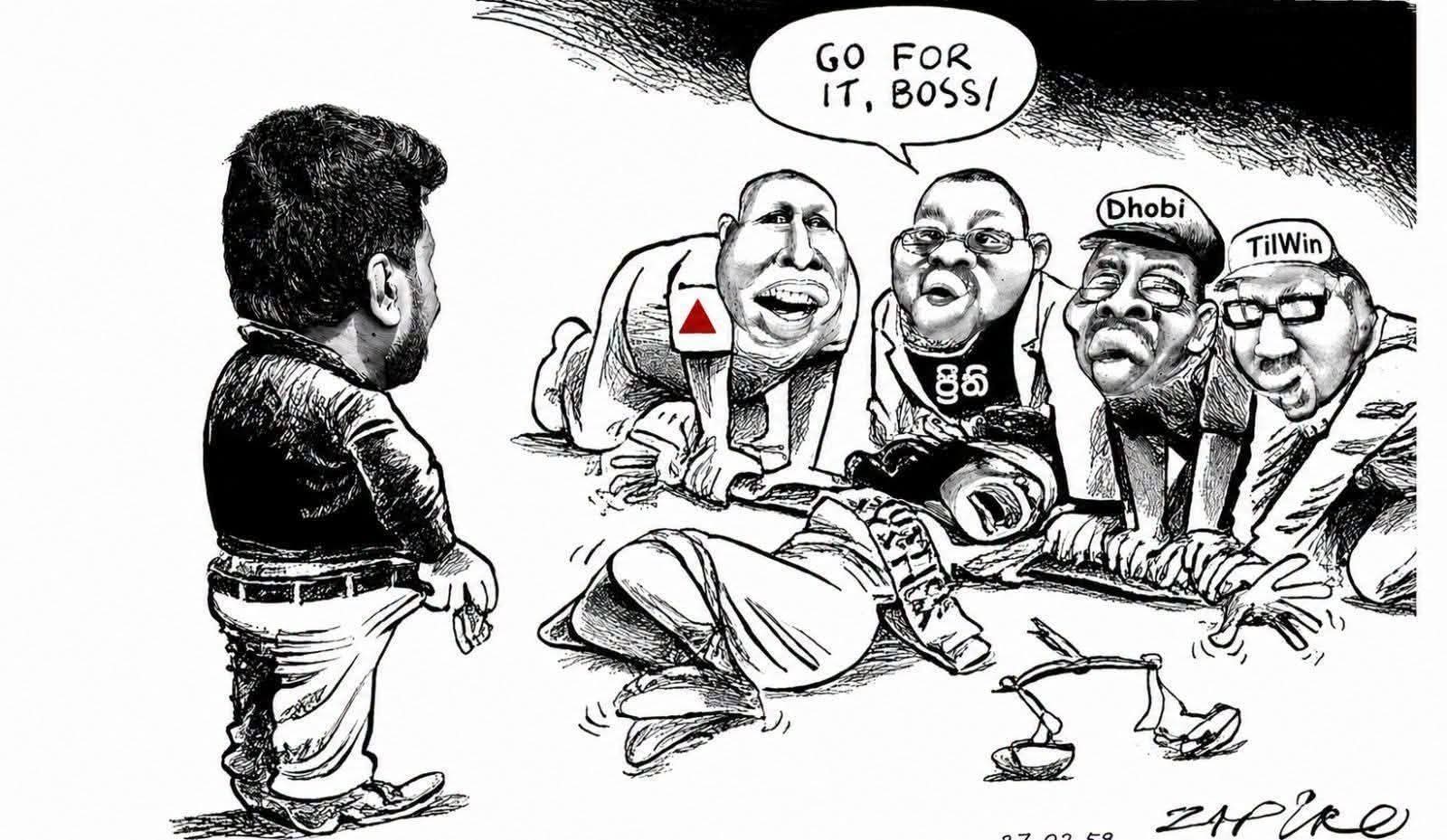
Wigneswaram holds President’s hands respectfully and stabs him in the back
The Northern Provincial Council (NPC) Resolution passed a resolution on February 10, 2015 accusing successive governments (from 1948) of committing ‘genocide’ against Tamils and called for an international commission of inquiry. This resolution has dealt the first deadly blow to the reconciliation plans of the Chandrika Bandaranaike-Ranil Wickremesinghe-Maithripala Sirisena regime brought into power by the bloc votes of the Tamils. The absurdity of this Resolution is revealed in its contradictions. On January 8, 2015 the TNA which runs the NPC votes President Maithripala Sirisena into power and on February 10, 2015 accuses him of heading the Defence Ministry “in May 2009, during the peak of the government’s attacks against Tamils.” Pin-pointing the role played by President Sirisena the Resolution states: “This Council notes that President Maithripala Sirisena was acting defense minister in May 2009, during the peak of the government’s attacks against Tamils. This conclusively demonstrates the need for justice and accountability for the Tamil genocide to be driven and carried out by the international community…..”
The drama that followed the passing of the Resolution makes the absurdity into an immoral farce. When President Sirisena asked for clarification from the NPC the Chief Minister C. V. Wigneswaran came down to Colombo, held the President’s hands and assured him that it was not against him or his government but it was against the Rajapakse regime. This contemptible act makes it clear that there is something lacking in Wigneswaran. What is missing, however, is debatable. Is it intelligence or shame? He knew he was lying through his teeth because President Sirisena is identified by name and accused of being acting defense minister at the height of the last stage of the Vadukoddai War. By naming him Wigneswaran had listed President Sirisena along with the others (example: Gen. Sarath Fonseka) who are identified as war criminals. Citing President Sirisena’s role in the war the NPC Resolution concludes : “This conclusively demonstrates the need for justice and accountability for the Tamil genocide to be driven and carried out by the international community…..” In other words, the TNA resolution states that President Sirisena too shoud be hauled up before the ICC for war crimes etc.
There is only one way of Wigneswaran regaining his reputation as a man of integrity : he should at the next meeting of the NPC report faithfully and truly what he told the President because one of the objectives of NPC was to brand every post-independent head of state, from D. S. Senanayake to Maithripala Sirisena, as criminals who committed “genocide” against the Tamils. Of course, the word “genocide” is used very loosely. Its elasticity is stretched to cover all and everything, from the Citizenship Act in 1949 to the liberation of the helpless Tamils used as a human shield to protect the Tamil Pol Pot.
There is also the other indefensible act of voting for President Sirisena and then charging him with war crimes in the Resolution. He is charged with being the acting defence minister at the height of the Vadukoddai War. Since the TNA knew President Sirisena’s role when he was the acting defence minister during the peak of the government’s offensive against Prabhakaran’s fascist regime and since the TNA was also out to get even with Sri Lanka for defeating their Pol Pot + Boko Haram why did the TNA decide to vote for him on January 8, 2015? Does this mean that the Tamil leadership was ignorant and stupid on January 8, 2015 when they voted for him and suddenly saw the light on February 10, 2015 to name President Sirisena as a war criminal? Or is this a continuation of the intransigent and unrelenting Tamil politics that led the innocent Tamil civilians, under their myopic leadership, from Vadukoddai to Nandikadal? As usual the NPC resolution confirms that Jaffna Tamil thinking has not been so bright: they always tend to take the wrong turn at the most critical times when opportunities came their way for peaceful co-existence.
Wigneswaran‘s role has also been exposed by the NPC’s Leader of the Opposition, S. Thavarajah. Commenting on the canine morality of unprincipled Wigneswaran’s stand he said that the Chief Minister shows one face in Jaffna and another in Colombo. Thavarajah hits him hard with the other side of the story. He says: “During the course of his speech, before presenting the resolution in the council, he read out a statement vehemently attacking the Government and the Prime Minister, in a harsh oratorically worded Tamil language…..
“The somersault by the Chief Minister, contradicting his own statement in the council, is a disgrace and shame. This has been the political tactics of TNA throughout. They arouse the feeling of the Tamils through their emotional appeals in order to get their votes and behave differently in Colombo for their personal gains.” (Ceylon Telegraph – 15/2/2015). The last sentence is a telling point. Whipping up the feelings of the Tamils through emotional appeals to get their votes has been the perennial tactic of the Jaffna Tamil leadership. Since this statement comes from another Jaffna Tamil nobody can accuse Thavarajah of being a Sinhala-Buddhist chauvinist reacting with a guilty conscience.
The NPC resolution reveals that there is an inherent demonic factor that bedevils Northern political culture. This has been the bane of peninsular political culture. It has been a destructive force, leading the Jaffna Tamils to tragic ends. Furthermore, their historical record leads to the inescapable conclusion that the Tamil leaders have been the first and the last to commit genocidal acts against their own people. The mass massacre of Tamil Catholics by Sankili is well-known. But take, for instance, the public record of the Chief Minister of NPC, Retd. Judge of the Supreme Court, C. V. Wigneswaran, who tried to capture the moral high ground by declaring in one of his speeches that he “will attend the Independence Day celebrations only after the country’s Tamils got freedom.” What he means is that the laws of the land have not given freedom to the Tamils. If he knew this to be true, what was he doing in the Supreme Court during his tenure as a judge? Did he once ever dare to declare from the Supreme Court bench that the laws were denying freedom to the Tamils?
On the contrary, was he not upholding the laws of the land which, according to him, constituted an instrument of oppression of the Tamils? Attending Independence Day celebrations is nothing more than a symbolic act at best. But upholding the law as a judge has far more serious political consequences. So why did this moral purist and defender of the Tamils impose on the Tamils the oppressive laws of the Sinhalese from the highest court of “the Sinhala State”, as the Tamils are wont to say? Why didn’t he resign on the pious principle that he propounds now saying that he would not be a part of “Independence Day celebrations until Tamils got freedom”? And why did he wait till he became a politician dependent on Tamil extremist votes to take this stand?
According to the litany of complaints in NPC resolution every law that affected the Tamils (language, citizenship etc) was a genocidal act against the Tamils. Going by his own logic isn’t Wigneswaram one of the criminals who committed genocide against the Tamils by administering the oppressive Sinhala laws? Doesn’t this confirm Thavarajah’s accusation that Wigneswaran is exploiting emotions of mono-ethnic politics to advance his career, irrespective of the consequences to the Tamil people? Is there no limit to his legal, political and moral hypocrisy?
The NPC resolution is teeming with political inaccuracies, statistical distortions, moral perversions, historical concoctions and damned lies. It is a tendentious document fabricated to denigrate what they call the “Sinhala State”, sweeping under the carpet the historical evidence that confirm the new status achieved by the Tamils in the post-independent era. The dignity, self-respect, freedoms that were denied to them throughout their history were granted fully to the Northern Tamils only in the post-independent years. Before that Jaffna was under various shades of fascism. Sankili represents the earliest phase fascism under the feudatories of the pre-colonial era. In the post-Portuguese period, particularly after the Dutch introduced the Tesawalamai law, the Vellahlas who penetrated every nook and corner of the peninsula succeeded in imposing their casteist regime which was as powerful as the political regime. Casteist fascism dominated every aspect of peninsular culture. When in 1976 they passed their power to the children of the Vadukoddai Resolution – the Tamil instrument that legitimized ingrained Vellahla violence – they transformed the north into a veritable hell-hole.
Vellahla casteist fascism was replaced by the one-man rule of Velupillai Prabhakaran. His political fascism based on the personality cult of a low-caste turned out to be the darkest chapter in the history of Jaffna. The Jaffna political culture began with Sankilli’s genocidal culture and ended with his true successor Prabhakaran. The oppressed Tamils had no space to breathe and live freely under all the Tamil regimes that dominated peninsular politics. The Vellahla oppression of the Tamils reduced them to subhuman slaves. The subsequent fascist oppression of Tamils by Velupillai Prabhakaran confirms that the Tamil leaders were the habitual criminals who ruthlessly committed genocidal acts against their own people. No leaders of any other community in Sri Lanka has committed such genocidal crimes against their own people as the Vellahlas and their anointed successor Prabhakaran. So when the NPC points one finger at the Sinhala south they must remember that the other four are pointing at them.
Apart from this, one of the basic fallacies of the NPC resolution is the attempt to paint a political scenario in which there is only one guilty party – namely, the Sinhala south. Every one of the accusations leveled against the successive states since independence can be challenged and torn to shreds. But there is no space in this single article to deal with all the issues comprehensively. To cut a long story, no one can deny that successive states blundered in several areas like any other post-colonial state facing challenges of nation-building. That is not in dispute. The dispute is in the validity of blaming only one side when two parties are locked in a do-or-die battle forced on the nation by outrageous demands of one party demanding two-thirds of its coastline and its hinterland for the exclusive use of 12% of the population, shutting out the rest. Irredentism of this kind is bound to be dead on water at birth.
Besides, separatism of this outrageous type is inseparable from violence. The violence of separatism provoked the counter-violence of the state. The unacceptable flaw in the NPC resolution is that it blames only one side for the violence that led to violations of human rights. The NPC resolution paints the unrealistic picture of one side using guns and bullets and the other shielding itself with silk saris and vertis. No moral judgment can be made credible by blaming only one side in a complex issue like the North-South conflict. Furthermore, if wars are considered evil then any judgment can be considered valid only by measuring the lesser evil that produces the greater benefit at the end of the day. So which side constituted the lesser evil? The short answer to this was given by two Tamil leaders. S. C. Chandrahasan, the son of S.J.V. Chelvanayakam, and V. Anandasangaree, the veteran Tamil leader of the TULF from the old brigade of Chelvanayakam.
The first to say that Prabhakaran has killed more Tamils than the others was Chandrahasan. Second was Anandasangaree. Both agreed that Prabhakaran had killed more Tamils than all the other forces put together. So if the Tamil Pol Pot has killed more Tamils than any other force who is it who has committed the genocidal attacks against the Tamils? Since the NPC resolution is obsessed with genocidal attacks on the Tamils why were the mass massacres committed by Prabhakaran not included in the Resolution? Why has the NPC failed to include in their Resolution the war crimes, crimes against humanity and “genocidal attacks” committed by the Tamils against the Tamils? Why the cover-up?
Besides, since the NPC is all about violations of human rights why is the NPC resolution aimed at seeking justice only for the Tamils? What about the Muslims and the Sinhalese who were the victims of Tamil terrorism documented in detail by the University Teachers’ for Human Rights (Jaffna)? Don’t they deserve justice? Or is it, in the words of Thavarajah, a move to exploit Tamil emotions for the leaders to collect Tamil votes? Overall, the NPC resolution should be read as a vindictive move to demonize the post-1948 states on a manufactured narrative that would give a shine to the Tamils as victims of majority oppression of a minority.
Not surprisingly, the NPC Resolution lists the alleged “genocidal acts” committed against the Tamils since 1948 and finds only the acts committed by the elected states guilty of committing “genocide”. It has studiously avoided the genocidal acts of the only “Tamil state” established by Tamil Pol Pot + Boko Haram in the Vanni. The elected state fought, quite legitimately, not only the fascists terrorists of the north but also of the south. The offensives of the elected states against the north and south fascist terrorist were in defence of protecting and preserving the democratic way of life. And the democratic states won in defeating the fascists terrorists in both regions.
The NPC Resolution, however, attempts to portray the post-1948 states as targeting only the Tamils. But the fact is that the states fought just wars in defence of democracy and its traditional values. The democratically elected states had a right to defend and protect the civilians facing threats to their lives and properties from unelected fascist terrorists, whether from the south or north. But the NPC distorts the political realities to project the post-independent states as anti-Tamil military machines fighting wars on ethnic lines. The refusal of the Tamil leadership to accept the hard historical realities facing them – mainly due to their exaggerated fixations about a history and a culture which can be written on the back of stamp – has been the primary cause that misled them all the way to Nandikadal. They provoke, initiate and organize violence to achieve their elusive political goals and when the elected states respond, as they ought to, they cry foul. They declared war in Vadukoddai knowing that it would lead to untold violations of human rights. Issues of human rights did not bother them one whit in 1976. It is only when they lost in 2009 that they paused to take refuge in human rights.
Ono of the main objective of the NPC Resolution is to divert attention away from the genocidal crimes of Tamils against Tamils and, of course, the other communities. Those seeking justice based on human rights cannot justify their cause by diverting attention away from their own crimes against humanity. But that is precisely what the NPC resolution has done. Besides, the arbitrary cut off point of 1948 too is introduced to point out that the violence of the democratically elected states were only to target the Tamils. To be fair and just to all, the NPC resolution should have started not from 1948 but from the time of Sankili who laid the political foundation for the Tamils to be slaughtered, oppressed, persecuted, and enslaved relentlessly down the ages by the ruthless Tamil leadership in the three main phases of Jaffna-centric history – 1). the feudatories of the early settlers established around 1325, 2). the Vellahla casteist rule under colonial masters and 3). the political fascism of Prabhakaran from 1976 to 2009,
The NPC resolution is aimed at, inter alia, taking the Sinhala leaders before the ICC. It is only comparable to dragging Churchill, Gen. Eisenhower and Field Marshal Montgomery before the Nuremberg Courts for liberating Europe from Nazi fascism and saving the lives of Jews and civilians trapped in a holocaust. The accusations leveled against all elected states since 1948 is as valid as saying that Gandhi is a violent man who violated human rights by endorsing Nehru act of marching into Hydrabad and integrating that state into the Indian union. Above all, it proves Thavarajah’s damnation of the Tamil leadership once again rousing Tamil emotion for gaining some political mileage.
The NPC Resolution has been counter-productive. It was produced in February to pressure the UNHRC to present its report on the last stages of the war in its session in March. The Tamil Diaspora also lobbied with all their might, using the NPC Resolution, to put maximum pressure on UNHRC not to postpone the presentation of its report on Sri Lanka. But the TNA dug their own grave by helping to elect the pro-West, pro-Indian presidency The victory they scored on January 8 boosted the image of the Sri Lankan state and blocked all moves to black list Sri Lanka in March.
But the UNHRC has thwarted the Tamil lobbies by agreeing to postpone the presentation of the report to September. This has thrown the Tamil lobby off balance. They now realize that the victory they scored in defeating Rajapakse has boomeranged on them. In the main, it has weakened the anti-Sri Lankan forces in the Tamil Diaspora. With anti-West Mahinda Rajapaksa the Tamil Diaspora was able to crank up their hate campaign against Sri Lanka in Western capitals. Now with the pro-West Sirisena the Tamil Diaspora has to grin and bear both in Washington and Delhi.
Wigneswaran, Sampanthan and Sumanthiran must be regretting their act of rushing into defeat Mahinda Rajapaksa. He was, after all, the best bet they had in two ways. First he liberated Jaffna from the grip of Tamil Pol Potism and gave the TNA the democratic space needed for them to play their games of politics the way the like. Second, he was the best available bogeyman available for the Tamils to demonize Sri Lanka abroad. But the postponement of UN report on the war to September has frustrated all the plans of the Tamil lobbies. The TNA dug their own grave by removing anti-West Mahinda Rajapakse and replacing him pro-West, pro-Indian Sirisena.
The Tamil Diaspora and the TNA has lost again. To the West and India protecting their Man in Colombo, Sirisena, is more important than pushing the claims of Tamil lobby. Once again the West and India have given the Tamils the karapincha treatment.
Once again the Tamil leadership must take responsibility for their folly. Though late they must be inclined to accept now the wisdom of what Mahinda Rajapaksa told the Tamils quite bluntly in the election campaign : “The known devil is better than the unknown.”
H. L. D. Mahindapala
(To be continued)
1051 Viewers