Deshabandhu Olcott Gunasekera – a Buddhist monk hereafter
“I do not like publicity for the sake of publicity but I would like to see if it is possible through your article to bring about an upturn of those renouncing the world and becoming monks in order to protect and foster the Buddha Sasana; to encourage parents from privileged backgrounds to gift their sons to join a noble (ariyo) clan. We have 2.3 million attending Dhamma schools and it should become the recruiting ground for new monks. But it is not so.
With what ease did persons of all ages renounce during the time of the Buddha!”
This is the reply I got to my request to Deshabandhu Olcott Gunasekera to write about him. I was told that he was renouncing lay life and seeking refuge in the ten precepts with the intention of gaining full ordination as a monk in the near future. When I enquired about the truth of this he said it was so. “On February 18 this year I turn 80. I shall undertake renunciation of lay life on that day. We usually give a dané to the monks at Vajiraramaya and Narada Bauddha Dharmayatanaya on that day, but this year I shall offer myself to the Sangha. I will go into retreat to study, reflect and meditate on Feb. 18 and then on March 5 I will be ordained at Vajiraramaya.” He pointed to a pile of books in his room at the Dharmavijaya Foundation on Sarana Road, Colombo 7 that included the entire Tripitaka and the commentaries that were gifted a few days back by the Sasana Sevaka Society, Maharagama in appreciation of his services to that institute for over 50 years. His intention is to master them during his period of retreat.
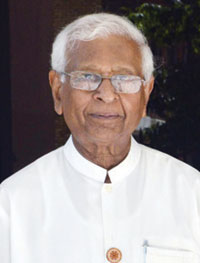 The impression I got of Mr Gunasekera when I interviewed him was inward joy, seen in his face which is always calm and kindly, reflecting the determination of a man who achieved so much right up to his late 70s. Asked whether his decision to become a monk was sudden or long thought of he replied that as a child he had a desire to join the Sangha, “renunciation then being in the vocabulary of society”. His parents too had been discussing this but according to their wishes he continued his studies excelling in school and moved on. Now that he is free of responsibility, or rather there are people to take on family responsibilities – his loving and understanding wife, Anula, and married daughter – he finally decided on ‘going forth’ in the footsteps of the Buddha by becoming a member of the unbroken line of monks. Blessed with good health, he felt it was time to grab the opportunity. He added that in his day and earlier, even during the restrictive ages of colonialism, renunciation was a societal norm with at least one son in a family being given to the Sangha. With a laugh he noted that a prophecy made by the Ven. Narada Maha Thera that “one day this boy will become a monk” was to come true on February 18. The Sri Lankan environment is conducive to renunciation and the opportunity has presented itself. So why not take it, is his contention. “Who knows what the next birth will be?” he added. He has been a teetotaller and a vegetarian all his life. Speaking about the latter, he explained that his parents had been influenced before their marriage by the sermons of the Italian monk Ven Lokanatha and Ven Narada Thera and once after a sermon, the dried fish and sprats in the larder of many homes were buried. His family, inclusive of his grandchildren, are vegetarian.
A recent experience undergone when attending a conference on tobacco control in South Korea rekindled his enthusiasm to become a monk. After the conference he spent some days in retreat at a ‘temple stay’ programme. His participation as a panellist on the 37 requisites of enlightenment at the invitation of Mr. Rajah Kuruppu over a period of nearly three years in the ‘Beyond the Vision’ programme of the Bauddha Nalikawa necessitated deep study. That was the final push that propelled him to total renunciation.
Life
Rajagalgoda Gamage Goshaka Olcott Gunasekera is the third in a family of five. He is the father of a son and daughter and has two grandchildren and recently celebrated his golden wedding anniversary with an alms giving at home and a Dhamma sermon at the Dharmavijaya Foundation by Ven. Tirikunamale Ananda Mahanayaka Thera on ‘Giving-up’ followed by dinner.
Moving around Ceylon as his father was in transferable government service, his primary education was at Southlands (Galle); Sri Pada (Hatton); Good Shepherd Convent (Kandy); Dharmaraja (Kandy); Dharmapala (Pannipitiya); St. Josephs (Colombo). His secondary education was in its entirety at Royal College, Colombo from 1946-52.
He obtained the B.A. (First Class) from the University of Ceylon, Peradeniya, majoring in history; M.A. (Merit Pass) from the Post Graduate Institute of Pali & Buddhist Studies, University of Kelaniya. He followed an Executive Program on Management, at the University of Stanford, Palo Alto, USA, in 1975.
Among several Academic Awards he won are: Ashok Prize for Indian History, University of Ceylon, 1957; Sir Baron Jayatileke Prize, Post Graduate Institute of Pali & Buddhist Studies, 1993. Mr Gunasekera is a Fellow of the Sri Lanka Institute of Management.
Government Service
He was selected to the prestigious Ceylon Civil Service (CCS) in 1958 after a gruelling interview with persons of the repute of Sri Nicholas Attygalle on the Board. He emerged with full marks. His cadetship he found to be a very appropriate preparation for taking responsibilities in major areas in the service of the nation. He served in the Ministry of Education and Broadcasting; Department of Official Languages; and was Government Agent Ampara and Batticaloa in 1964-65. He was Commissioner of Probation and Child Care Services and later of Cooperative Development, and was even Additional Director of Establishments in the General Treasury. Retiring from government service in1973, on abolition of the CCS, he continued to hold high posts in the cooperative movement, in agriculture and banking sectors and land reform. His expertise and wide experience have been utilized by foreign agencies. He was Regional Consultant, Cooperatives, Credit & Marketing 1980 – 1991 attached to the Regional Office of the Food & Agricultural Organization of the UN (RAPA), Bangkok.
His research and surveys have been equally noteworthy, such as the impact of drug use on programmes for alleviating poverty – Hambantota District; Sentinel Tobacco Use Prevalence Survey – Sri Lanka, 2001, WHO/SEARO; Prevalence of Alcohol Use in Sri Lanka, 2001 and in the Colombo National Hospital and FCTC-compliant Legislation for Tobacco Control – Sri Lanka, 2005, WHO/SEARO
Publications
Several regional publications of the FAO RAPA; over 50 articles on development issues, Buddhism, cooperatives, history, and substance abuse in local and foreign journals. Articles in English on Buddhist themes authored by him are published as Buddhism in Practice – 1 (2014) and 2 (2015); A collection of some of his articles in Sinhala will follow (2015).
Deshabandhu Olcott Gunasekera has given of his time, energy and life itself to community service in several areas both locally and internationally, mostly on alcoholism and tobacco control. The list of such service is far too long to record here. Suffice it to mention that he has served the nation and its people, mostly the disadvantaged through being chairman or executive member of organisations such as the National Council of Social Services/ All Ceylon Buddhist Congress; Royal Asiatic Society of Sri Lanka; IOGT Regional Council for South & South East Asia; Alcohol & Drugs Information Centre (ADIC) Sri Lanka and Sri Lanka Temperance Association
My personal view is that he has done most work and of a meritorious nature as Founder President of the Dharmavijaya Foundation – the materialization of the vision of Most Ven Madihe Panhaseeha Mahanayaka Thera in 1977. He served as president for 32 of the Foundation’s 38 years. The service carried out by this Foundation is across most provinces of Sri Lanka with concentration on the development of the individual on Buddhistic principles; and on health, education and poverty reduction. He is also President, Sri Lanka National Federation on Smoking and Health; Founder President, Red Lotus Organization for Humanitarian Services 2006 onwards and Sri Lanka National Association of Family Clubs 2008 -2015. He is honorary President of the Asian Buddhist Congress
National & International Honours
He won the Lakshmi N. Menon Birth Centenary Award for Regional Cooperation for his outstanding contribution in the field of Substance Abuse Prevention -1999 (India). He was awarded the national honour of Deshabandhu (Titular) by the Government of Sri Lanka for distinguished service of a meritorious nature to the Nation – 2005; The Ruben Wagnsson Medal by IOGT International for contributions in alcohol control and policy – 2006;
The title, Dhammavijitãvi Sãsana Ranjana was given him by Amarapura Sri Dhammarakshita Nikaya on its 200th anniversary in 2007. Also the Red Orchid Award and Certificate of Recognition by the Framework Convention Alliance on Tobacco Control – 2014; Justice of Peace for the whole Island – 2014
Event of Appreciation
In expressing their gratitude and bidding farewell to their Founder President, the Dharmavijaya Foundation organised an all-day event on Thursday February 12 at their headquarters on Sarana Road. It comprised a noon dané to 15 monks, and a meeting where speeches were made in recognition of the vast amount of work done by Deshabandhu Olcott Gunasekera benefitting thousands, nay millions of people.
It was a touching goodbye. However, joy had to be the primary emotion because this person who had lived such a full life was giving up all his lay connections, even to the Dharmavijaya Foundation to which he was devoted, to go forth to reach Nibbana all that sooner. Hence no sadness, no regret, only appreciation that this excellent man was renouncing all to join the blessed Sangha.
2136 Viewers