Gota’s US Citizenship: Rapid Renunciation to suit US Interests!
(Courtesy of Asian Tribune)
Leading to Sri Lanka’s presidential election on Saturday, November 16, the renunciation of American citizenship of Sri Lanka Podujana Perameuna party candidate Gotabaya Rajapaksa has dominated the media cycle, the opponents of the Rajapaksa candidacy casting aspersions that he is disqualified under the Nineteenth Amendment to the Constitution, as they say, there was no credible and cogent evidence of his renunciation.
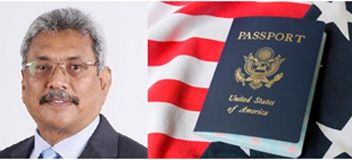
The Nineteenth Amendment of the Sri Lanka Constitution ratified in 2015 qualifies only a Sri Lankan citizen to stand for elections either for the presidency or the legislature; no dual citizen is eligible to stand for election.
To justify the argument that Mr. Rajapaksa has not renounced his U.S. citizenship, they point out that the U.S. Government Federal Registry – issued by the US Department of Treasury – to date, has not carried his name as a person whose American citizenship has been officially renounced.
It has now come to light that the former defense secretary (2005-2015) Rajapaksa who oversaw the successful conclusion of the 26-year separatist war in 2009 launched by the Tamil Tiger outfit – exemplarily providing far-sighted and expert management- received a rapid renunciation of his American citizenship from the United States federal government despite the same government accused him of war crimes and violation of international humanitarian law (IHL), under which an American citizen is normally subjected to the scrutiny of a serious federal law – War Crimes Act of 1996.
As this writer has some understanding of how the American mind-set works because of the engagement at the U.S. Federal Government in the capacity of a Foreign Service national political specialist at its diplomatic mission in Colombo, Sri Lanka, the speedy renunciation of Mr. Rajapaksa’s citizenship raises many questions: Washington’s possible ‘gamble’, in the event he assumes the presidency and followed by his political party gaining a majority in the legislature with his older brother and onetime president Mahinda Rajapaksa assuming the most powerful executive prime minister position – under the provisions of the Nineteenth Amendment – amidst a developing scenario in the Indo-Pacific region, the rapid expansion of American military power; Washington’s endeavor to use the whole of Sri Lanka as a ‘military hub’ (as opposed to opening a base in some part of Sri Lanka) due to its strategic location at the center of Indo-Pacific region; the sustenance of the 83-page military pact – Acquisition and Cross-Services Act; to expedite the pending Status of Forces Agreement (SOFA) which brings American boots to Sri Lanka’s soil with diplomatic immunities to activate the ACSA; the controversial Millennium Challenge Corporation Compact, all of which could be a fillip to Washington’s military maneuvers in the region.
The Asian Tribune U.S. Bureau, using its contacts, has found answers to the issue of the allegation toward the ‘non-appearance’ of Mr. Rajapaksa’s name in the Federal Registry: the allegation has no substance as found by the Asian Tribune when scrutinizing the management style of the U.S. federal agencies. The ‘non-appearance’ issue will be dealt followed by the ‘urgency’ the with which Washington treated Gotabaya Rajapaksa’s application for the renunciation of the U.S. citizenship.
Mr. Rajapaksa visited the American Embassy, Colombo in March 2019 to file papers for the Loss of Citizenship application, received official confirmation on 3 May from the U.S. government that he was not considered a U.S. citizen, effective 17 April.
Despite Washington strong belief that the three Rajapaksa brothers and the head of the army Sarath Fonseka committed war crimes during the Eelam War IV (2006-2009) based on the January 15, 2010 classified cable and other reports to Washington dispatched by the Colombo US diplomatic mission, and Colombo U.S. Embassy’s outright refusal to grant entry visas to many military personnel on the premise that they committed war crimes – although never established at the time of refusals – Gotabaya Rajapaksa, who planned and executed the overall military offensive, never faced any scrutiny when he applied to renounce his American citizenship; the application was accepted with no internal probe by the US Department of Homeland Security, which investigates alleged human rights abuses and war crimes, in regard to his role during the four-year military offensive against the separatist-terrorist Tamil Tigers.
The said diplomatic cable authored by Ambassador Patricia Butenis declared “responsibility for many of the alleged crimes rests with the country’s senior civilian and military leadership, including President Rajapaksa and his brothers.”
In December 2009 the State Department’s Office of Global Criminal Justice had submitted its ‘War Report’ to the US Congress, as mandated by the legislature, accusing Sri Lanka of war crimes.
Based on the above, the United States initiated the Resolution 30/1 in October 2015 in UNHRC (Geneva) which advocated an investigation jointly by Sri Lankan and international jurists.
As a United States’ citizen, former Sri Lanka defense secretary Gotabaya Rajapaksa came well within the investigative judicial system when applying for the renunciation of his citizenship. In his application he clearly stated, as required by the U.S. law, in what capacity he served a foreign government. It is a practice, and the law, that a US citizen born in another country applying for renunciation of U.S. citizenship, such person undergoes a thorough scrutiny in the US Department of Treasury and the Department of Homeland Security.
Taking into account his previous role in Sri Lanka, as officially manifested in numerous U.S. federal documents, Mr. Rajapaksa comes within the purview of the War Crimes Act – a legal windfall for any US effort to investigate him across international borders. His citizenship also expands US policy space – by reducing US vulnerability to accusations of meddling if US goes after one of its own. (In Rajapaksa’s case, the U.S. considers him ‘one of its own’ as he is a citizen of the United States) Such investigations take many months to ascertain a person’s culpability or not. Taking into account the diplomatic cables that reached Washington, the other reports accompanying them, and the published unclassified (USG) documents about Sri Lanka’s Eelam War IV, and the role played by defense secretary Gotabaya Rajapaksa, one of the principal architects of the offensive against the Tamil Tigers, the responsibility of probing an American citizen’s involvement – amid serious allegations – rests with the US Department of Homeland Security. In the DHS, U.S. Immigration and Customs Enforcement’s (ICE) Homeland Security Investigations (HSI) operates the Human Rights Violators and War Crimes Unit (HRVWCU) within the National Security Investigations Division (NSID).
The manner in which Gotabaya Rajapaksa received the speedy renunciation of his American citizenship, despite previously being declared in official United States Government documents of his and his brothers’ alleged complicity in human rights violations and war crimes – despite no allegation has been proved or established – in comparison to how Washington treated Sri Lankan military commanders, including onetime army commander Sarath Fonseka, all of whom served under the command of the defense secretary Rajapaksa, in refusing entry to the United States over war crimes allegations, and rejecting some Sri Lanka Defense Ministry nominees from the military for training in the United States for their alleged involvement in human rights abuses and war crimes speaks volumes of Washington’s mind-set, quite familiar to this columnist, and its future projections and maneuvers taking into account the military build-up in the Indo-Pacific region.
Washington formulates its national policies in the interest of its own national security and trade and economic benefit. In this case, Washington possibly gambled in linking the militarization of the Indo-Pacific region to Gotabaya Rajapaksa’s application for a speedy renunciation of the U.S. citizenship as it was well aware that if it delayed the renunciation in prolonging a DHS probe based on the reports the Departments of State received – however much they may be weak or no justification of war crimes and human rights abuses – it would have been detrimental to his political aspirations. So was to Washington’s projections to keep Sri Lanka as a ‘willing partner’ in its overall military endeavor in the Indo-Pacific region. The gamble Washington took in a speedy resolution of his citizenship issue in linking it to ACSA and other proposed military agreements such as SOFA is its overall militarization of the Indo-Pacific region which the Trump administration launched since its advent in early 2017. Washington needs Island of Sri Lanka as a single unit to transform into a ‘military hub’ – as opposed to opening a military base – to execute its Indo-Pacific regional militarization plan. The speedy resolution of the citizenship issue is a safe gamble well linked to America’s strategy to use Sri Lanka in such a manner under a Rajapaksa administration.
Washington is well aware that the imminent return of the Rajapaksas’ could be crucial to its operation in the Indo-Pacific region considering the strategic location of Sri Lanka, and toward that an ACSA, SOFA and many other military agreements are vital components to achieve military supremacy.
These are Washington projections, as learned by the Asian Tribune, may take a different turn under a Gotabaya-Mahinda Rajapaksa administration. For Washington to fulfill the projections, it uses carrot and sticks as known to those who closely monitor the manner in which it discharges its foreign policy.
One such carrot and stick Washington use is trade and commerce:
The US continues to be the single largest export destination for Sri Lankan products with over 25% of its exports. Sri Lanka’s exports to the US demonstrated an impressive growth of 35.7% in 2017 compared to 2011. According to the latest trade statistics, Sri Lanka’s exports to the US amounted to US $ 2.9 billion in 2017 and US $ 3 billion in 2018.
Total Imports to Sri Lanka from US in 2017 was US $ 811 million, while total trade turnover between Sri Lanka and the US remained at all-time high of US $ 3.7 billion. The balance of trade is in Sri Lanka’s favor amounting to US $ 2.1 billion in 2017 and US $ 2.4 billion in 2018.
It is in this context that one could see the one-hundred-and-eighty-degree twist of Washington which held strong views about committing war crimes during the Eelam War IV to safeguard its national security interests. Washington’s projections, and the U.S.’ strong commitment to militarize the region using ‘willing partners’ in the Asian region would have led Washington to take a totally different outlook toward Gotabaya Rajapaksa’s request for the renunciation of his U.S. citizenship in contrast to the strong-arm policy it adopted toward many senior incumbent and retired military officials, who served under Mr. Rajapaksa’s command and directives, in its forthright refusal to grant entry visas to the United States on the premise they committed war crimes and violated international humanitarian law (IHL) during the (2006-2009) years of the Eelam War IV.
It should be noted here that those whose entry visas were rejected by the U.S. diplomatic mission in Colombo on Washington’s specific instructions had not been found guilty of any crime. Since they were not American citizens, they do not come within the jurisdiction of the U.S. investigative judicial system – the War Crimes Act – to ascertain their culpability or not.
In the Indo-Pacific region with the role of the United States growing more visible and prominent, the importance of US Indo-Pacific Command’s (USINDOPACOM) force sustainment plans and procedures during the time Sri Lanka entered into ACSA in 2007 was crucial. The U.S. launched the Global War on Terrorism since 9/11 and wanted ‘willing partners’ to execute it. And now the Trump Administration using the Congress-ratified ‘Asia Reassurance Initiative Act’ , the USINDOPACOM needs logistic support to combat Chinese military and political expansion in the East, South and Central Asian regions. It is in this context that Sri Lanka has become crucial to Washington.
On December 31, 2018 President Trump signed the ‘Asia Reassurance Initiative Act’. The Act specifically calls for America’s increased engagement in the Indo-Pacific region and strengthened support, including arms sales, for U.S. allies in the region. The act develops a long-term strategic vision and a comprehensive, multifaceted, and principled United States policy for the Indo-Pacific region.
Washington’s forward look to use entire island of Sri Lanka as a military hub to which the Sirisena-Wickremasinghe administration put a firm foundation in agreeing to the ‘open-ended’ 83-page ACSA in August 2017 was a promising forward step in roping a ‘willing partner’ toward its militarization in the Indo-Pacific region. The secretive nature of the manner in which the ACSA was negotiated and broadened from 8 pages to 83 pages and maintaining it as a classified document speaks volumes to what extend the United States has negotiated for its own benefit. The SOFA, which is now on hold with pending negotiations, is another arrangement that facilitate the activation of the ACSA. Washington needs assurance from Sri Lanka’s next administration, either Rajapaksa or Premadasa, that these military agreements – which are useful links to the overall Indo-Pacific military endeavor – stay its course.
The speedy resolution of Gotabaya Rajapaksa’s US citizenship renunciation, if linked to Washington’s military strategy in the Indo-Pacific region, is something which is interesting. In the near past Washington used human rights and war crimes as issues to deny senior military personnel – both serving and retired – of entry to the United States. Most of whom the visas were denied – during the Eelam War IV – served under defense secretary Gotabaya Rajapaksa who directed the Eelam War IV operation. Washington often uses scenario and developments for its own advantage. It took different approaches to the 1988-1989 JVP youth insurrection in which thousands of youths were tortured and killed in the broad view of American diplomats accredited to Colombo. A report to that effect is now on display in this newspaper web site.
To address the issue of Gotabaya Rajapaksa’s name not appearing on the Federal Register of the U.S. Department of Treasury:
The Sri Lankan presidential candidate Gotabaya Rajapaksa whose name failed to appear on the U.S. government’s quarterly list of individuals who have renounced their citizenship is inadvertently drawing attention to a question many Americans and former Americans have been asking for years – which is why it can take months for renunciants’ names to appear on the list.
Some renunciants say they have been waiting more than a year, and believe they may never see their names on the Federal Register’s official “Quarterly Publication of Individuals Who Have Chosen to Expatriate, as Required by the Internal Revenue Code Section 6039G which provides information on individuals losing U.S. citizenship.
Spokesperson for the Internal Revenue Service said that “we cannot publish the names in the Federal Register until we receive the information needed to make a determination of the expatriation. We do not publish names of former citizens until we receive a CLN – Certificate of Loss of Nationality – from the State Department, and we do not publish names for former long-term permanent residents until we have both the information from USCIS and the 8854 from the individual expatriate.”
The Federal Register list, he said, is compiled from information “provided by the State Department and the Department of Homeland Security, as well as the Forms 8854 – the Expatriation Information Statement -filed with the IRS,” which “many, but not all, affected individuals are required to file.”
The Asian Tribune found the fact that U.S. citizenship renunciants’ names often take a long time to show up on the Federal Register has become one of the most often-asked questions among long-term Americans and former Americans.
The obvious answer the Asian Tribune found is that the U.S. government doesn’t view getting the names of the latest group of citizenship renunciants onto the Federal Register in time to make the quarterly deadline as one of its top priorities.
Back in September 2015, for example, Forbes tax writer Robert W. Wood observed that “many people who have expatriated claim their names are never on the IRS list”, that is, the one that appears on the Federal Register’s website.
One former American who now has a British passport told the American Expat Financial News Journal that she had “renounced in December 2018, and my CLN [Certificate of Loss of Nationality] is dated January 2019, and yet I wasn’t on the Q4 2018 list, the Q1 2019 list, or the latest list.
By Daya Gamage
244 Viewers