Namal Pokuna – Oasis for Sernity
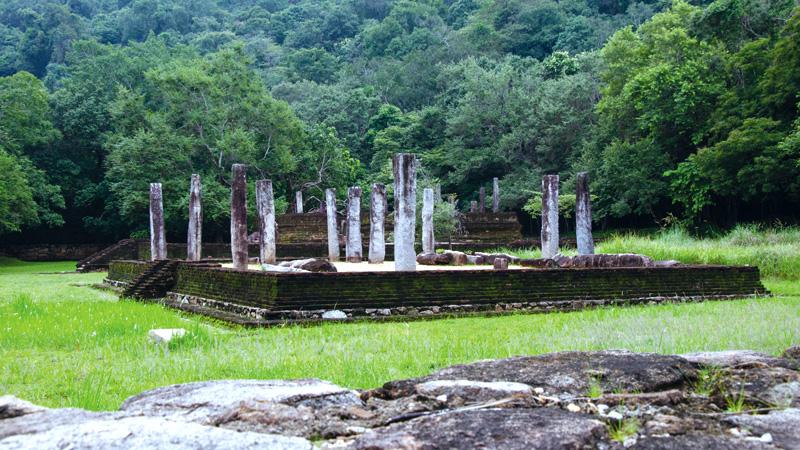
It was morning. We could see the silhouette of the Dimbulagala mountain range with its jagged peaks thrusting against the pale blue sky. The air was a little chilly. The placid water of the Dalukana tank could be seen on the left side of the road, lying in the foot of the Dimbulagala hill. Across the tank, a soft, cool breeze blew through the leaves of trees. The shade and the soothing swishing sound of leaves mesmerised us. We closed our eyes and breathed in the serenity. Our destinations were Namal Pokuna Purana Raja Maha Vihara, Dimbulagala Arannaya Senasanaya (forest hermitage) and Dalukana, often referred to as an Adivasi (Veddha) village, 10 km from Manampitiya, an ancient Adivasi village, which was home to one of the earliest Adivasi clans. We were at the Namal Pokuna Raja Maha Vihara, Dalukana, with the expectations of meeting Adivasi Bhikkhu Ven. Millane Sri Siriyalankara Thera, who resided in the temple where Adivasis have left marks of their civilisation in caves, most of which have vanished. We were told at the temple that the Adivasi bhikkhu now resides in Dimbulagala, after he became a Chief Incumbent of the Dimbulagala forest hermitage. We headed to Dimbulagala to meet the Ven. Millane Sri Siriyalankara Thera. Sitting on a bench under a shady mango tree in front of the spacious compound of the Avasa Ge at the temple on the foot of the Dimbulagala mountain, the Thera spoke about the temple and reminisced his childhood with us.
History
The history of Dimbulagala and its forest hermitage, which had sheltered thousands of Bhikkhus in the past, dates back to the reign of King Pandukabhaya. It had been overgrown with creepers after the Chola invasion and had later become a home for the Adivasi.
Millana Yapa, the last chieftain of the clan who lived in the caves in the Dimbulagala forest had decided to gift all the natural caves to a Bhikkhu along with 12 Adivasi boys, to be ordained as Samanera bhikkhus. Ven. Millane Sri Siriyalankara Thera, Viharadhipathi of the Dimbulagala forest hermitage, was one of these boys. “When we were small, we lived in caves. We didn’t have money. We took honey, dried meat, maize and fruits such as Mora and Weera to the Kaduruwela town and sold them, got our provisions and returned to our caves. Whenever we suffered from any disease, we used medicine based on tribal methods. We bathed in the Avushadha Pokuna (herbal pond), on the Dimbulagala mountain, which was believed to cure all diseases,” the Thera said.
Millana Yapa, the last chieftain of the clan who lived in the caves in the Dimbulagala forest had decided to gift all the natural caves to a Bhikkhu along with 12 Adivasi boys, to be ordained as Samanera bhikkhus. Ven. Millane Sri Siriyalankara Thera, Viharadhipathi of the Dimbulagala forest hermitage, was one of these boys. “When we were small, we lived in caves. We didn’t have money. We took honey, dried meat, maize and fruits such as Mora and Weera to the Kaduruwela town and sold them, got our provisions and returned to our caves. Whenever we suffered from any disease, we used medicine based on tribal methods. We bathed in the Avushadha Pokuna (herbal pond), on the Dimbulagala mountain, which was believed to cure all diseases,” the Thera said.
“The caves were gifted to Ven. Matara Kithalagama Sri Seelalankara Thera by my father, Millana, who was the chieftain of the Adivasi clan in Dimbulagala. The caves which we lived became Buddhist shrines and dwelling places of meditating bhikkhus.”
“The Viharadhipathi built a school for us in Horiwila. It was an enjoyable life in school,” he said.,,,,
“The Viharadhipathi built a school for us in Horiwila. It was an enjoyable life in school,” he said.,,,,
Courtesy of SUNDAY OBSERVER
74 Viewers