UN has irrefutable evidence on exact casualties in Lanka, but is ignoring by Pillay
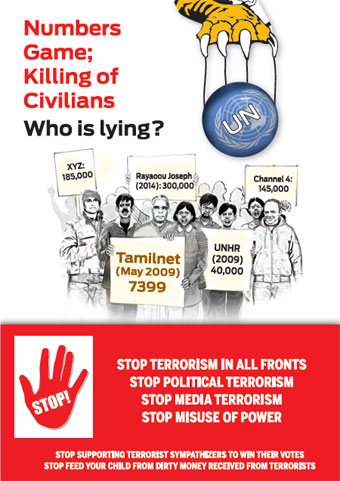
The UN was having irrefutable evidence that would contradict the much touted allegation that indiscriminate military action had caused the deaths of 40,000 civilians during the last phase of the war on the Vanni east front, Chief of Defence Staff Gen. Jagath Jayasuriya said.
Pointing out that that many referred to the January-May 19, 2009 period as the final phase, Gen. Jayasuriya said that the UN mission in Colombo had estimated the number of deaths at 7,721 from August 2008 to May 13, 2009. The army brought the ground offensive to a conclusion six days later with the killing of LTTE leader Velupillai Prabhakaran on May 19 morning. The same report placed the number of wounded at 18,479.
Those who had been killed and wounded fighting for the LTTE too, were also listed by the UN.
The former Security Forces Commander, Vanni (July 2007 to July 2009) emphasized that the proposed UN investigation team would have to closely examine the report prepared by the UN Country Team, though the UNSG Ban Ki Moon’s Panel of Experts (PoE) rejected it.
The former army commander (July 2009 to August 2013) said that the report prepared on the basis of information gathered by the UN had been gathering dust, while various interested pro-LTTE Tamil terrorists parties propagated vastly varying figures to justify a war crimes probe. Nothing could be as ridiculous as the claim made in House of Commons in September 2011 that 40,000 civilians and 60,000 LTTE personnel died during January-May 2009 period, Gen. Jayasuriya said. The CDS was responding to a statement made by Labour Party MP Siobhain MacDonagh.
Estimates of Civilain Deaths by Various Parties in the War Zone During the Final Phase of the War in Sri Lanka with the LTTE Terrorists
| S.no | Date | Source | Number of Deaths | Comments (The estimate except where stated otherwise, cover the period from 1st January to 19th May 2009) |
| 1 | 2011 | Dr. Rohan Gunarathna | 1,400 | Dr. Gunarathna, a well-known researcher who has written authoritatively on “internal Conflicts”, is quoted in Roberts (2013). |
| 2 | 2012 | V Shanmugaraja | 2,500 | Dr. Shanmugaraja served as a senior medical officer in the LTTE controlled areas throughout 2008 and up to about 14th May 2009 at places close to the LTTE operation centre. His estimate is mentioned in a legally valid affidavit. |
| 3 | October 2009 | U. S. State Department Report | 7.700+ | The report submitted to the U.S. Congress (Source: The UK daily, The Guardian, of 16th December 2010). |
| 4 | 2009 | U.S. Country Team | 7,737/17,700 | From early January to 13th May – 7,7,37. With extrapolated values for the days thereafter the overall total has been increased to 17,700. However, in the light of the Indian journalist Reddy’s spot report there were no civilians left in the LTTE held 1.5km2 by 15th May. |
| S.no | Date | Source | Number of Deaths | Comments (The estimate except where stated otherwise, cover the period from 1st January to 19th May 2009) |
| 5 | 2013 | Independent Diaspora Analysis Group | 15,000 | The report could be access via the website of the Institute of Conflict Management , Delhi. |
| 6 | 1. Rajasingham Narendran 2. Muthukrishnan Sarvanandan 3. Noel Nadesan |
6,000-10,00010,000
11,000 |
These three are Tamil Professionals who have tendered to adopt a “moderate” stand vis-à-vis the eelam campaign. Their estimates are evidently based on various orally conveyed and documented sources of information. (source: Roberts) (Contd.) |
|
| 7 | 2013 | Michael Roberts | 10,000-18,700 | Prof. Roberts is a western researcher and author of many scholarly works on the Sri Lankan conflict and other topics. |
| 8 | Institute of Conflict Management , Delhi | 11,111 | Civilian deaths in the year 2009, presented in a tabulation title; “Fatalities in Terrorist Violence in Sri Lanka, 2000-2014”. Source: ICM-Terrorism Portal website |
|
| 9 | 2011-2012 | Department of Census and Statics a | 7,400 | All deaths “due to unidentified other causes’ said to be based on an official field survey. |
| 10 | Nov-2012 | Darusman Report | 40,000 | The report was prepared by the member panel appointed by UN secretary General. What the report says is that the civilian death toll could have been as high as 40,000. |
| 11 | 2019 | UN internal review panel | 70,000 | Report states that the civilian death toll could have been as high as 70,000. |
| 12 | 2009 | University Teachers for Human Rights-Jaffna | 20,000-40,000 | The UTHR-J has regularly ‘monitored’ the Sri Lankan conflict and other conflicts and/or human rights since violation since the late 1980s. |
| 13 | Alan Keenan | 40,000-147,000 | Keenan was the chief of the Colombo Unit of the ‘International Crisis Group’ (which has been fiercely hostile towards Sri Lanka) headed by Gareth Evans, and anti-Sri Lanka campaigner | |
| 14 | Dec-2012 | Frances Harrison | 50,000-101,748 | Harrison was a Colombo-based BBC correspondent (2002-04) and has continued to be hyper critical of the government of Sri Lanka, demanding stern action against alleged ‘war crimes’ |
External Affairs Minister Prof. G. L. Peiris recently declared that the government wouldn’t cooperate with UN investigators under any circumstances.
The UN requested government clearance to visit Sri Lanka during July-November period to conduct investigations. Gen. Jayasuriya said that the UN couldn’t ignore its own report. Responding to a query, Gen. Jayasuriya said as the UN report had been based on information provided by the Regional Director of Health Services (RDHS), national staff of the UN, NGOs as well as the ICRC, the UN could easily get in touch with them.
Gen. Jayasuriya said that as the PoE had recommended that the identities of those who had provided information to the group wouldn’t be revealed until 2031, the on-the spot UN report could be the basis for the proposed inquiry. The General said that regardless of Sri Lanka’s participation in the inquiry, the UN couldn’t ignore available evidence.
The CDS said that beside the accusations as regards civilian deaths as well as alleged battlefield executions during the last 72 hours ending 9 am on May 19, Sri Lanka was accused of coordinated artillery fire at civilians, depriving civilians of medicine and food, compelling all foreigners to leave the Vanni and systematic rape of both combatants and civilians. Subsequently, Sri Lankan military was also accused of sexually abusing LTTE suspects, the General said.
Gen. Jayasuriya said that those who had served the UN, INGO, ICRC, WFP and India could help the investigation undertaken by UN human rights commissioner, Ms Pillay. The top army officer pointed out that a government planning mass scale slaughter would never have organized food convoys (Oct 2008-January 2009) to Vanni east before sending food ships (February 2009-May 8, 2009). UN investigators could easily verify facts from the WFP and the ICRC, Gen. Jayasuriya said, explaining the circumstances under which the government allowed a large Indian medical team at Pulmoddai, north of Trincomlaee during the last phase of the offensive to treat those wounded in fighting. In fact, the wounded LTTE cadres too, had been evacuated in the ICRC-led operation, Gen. Jayasuriya said, adding that those who accompanied the wounded as well as other patients numbered about 8,000.
Having completed its mission at Pulmoddai, the Indian team moved to Menik farm, Gen. Jayasuriya said. Those Indians who had served in Sri Lanka during the conflict would be able to provide information, he said. But nothing could be as significant as the then US defence advisor Lt. Colonel Lawrence Smith’s response to a query by retired Indian Maj. Gen. Ashok Metha in early June 2011 at a defence seminar in Colombo. Pointing out that Lt. Colonel Smith was speaking two years after the conclusion of war, Gen. Jayasuriya said that the US official dismissed allegations made against the Sri Lankan Army.
692 Viewers