US- Lanka ’07 ACSA: Gota says ‘It helped Sri Lanka’, U.S. says ‘It helped them’
(Courtesy of Asian Tribune)
At a time Sri Lankan nation is engulfed in a serious debate whether the United States’ military could possibly have a foothold in Sri Lanka with the July 2017-signing of the Acquisition and Cross Services Agreement (ACSA) and the impending settlement of modalities of the Status of Forces Agreement (SOFA) between the United States and Sri Lanka, Sri Lanka Podujana Peramuna (SLPP) presidential candidate Gotabaya Rajapaksa declared at his maiden press conference in Colombo on October 14 that Sri Lanka benefited with the signing of the ACSA in 2007, the forerunner to the 2017 military pact.
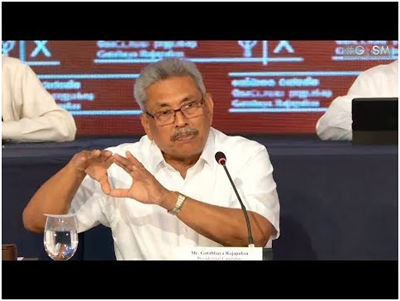 presidential candidate Gotabaya Rajapaksa making a point at 14 October ‘Meet The Press’ event in Colombo, his maiden exposure to the Local and international media
The signatories to the 2007 ACSA were Gotabaya Rajapaksa, the then Sri Lanka’s Secretary of Defense and Robert Blake, Washington ambassador to Sri Lanka who was authorized to sign on behalf of the U.S. Department of Defense.
Two classified diplomatic cables originated from the Embassy of the United States of America in Colombo to the U.S. Department of State a month before the March-2007 signing of the military pact between the two nations, seen by Asian Tribune, confidently declared that the ACSA was in fact beneficial to the United States, and do not indicate the military deal arranging a nature of a quid pro quo.
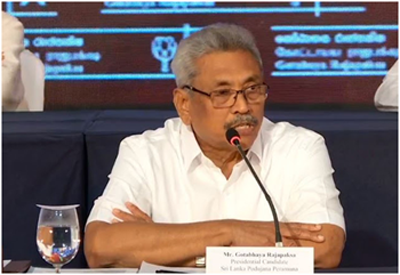 SLPP presidential candidate addressing the national and international Media in Colombo 14 October in which he declared the military pact ACSA of 2007 he signed with the U.S. benefited Sri Lanka
Taken from the one-hour-fourteen-minute video of the press conference provided to the Asian Tribune, the question posed to presidential candidate Gotabaya Rajapaksa was: “You mentioned your foreign policy will be neutral and non-aligned. What will be your position about ACSA agreement signed with the U.S. and planed-sign-up of SOFA. I didn’t see how these agreements can keep in a non-aligned position” to which Mr. Rajapaksa replied: “Actually the Agreement we signed was a different one. It was on for ten years. Nothing actually happened. The 2007 ACSA benefit was for us not for them. I am always for a sovereign-independent nation, and I will not do anything against that.”
Mr. Rajapaksa, who signed the 2007 ACSA on behalf of the Government of Sri Lanka, was confidently declared that Sri Lanka benefited from that agreement not the United States.
Prior to the signing of the 2007 ACSA, the classified diplomatic cables that were sent from the American Embassy in Colombo under the signature of Ambassador Robert K. Blake tells a different story. Here’s what the cables said:
The 20 February 2007 diplomatic cable dispatched to Washington signed by Ambassador Robert Blake stated:
(Quote) Sri Lanka, positioned astride major sea lanes and at the doorstep to India, can play a significant role in military readiness as political and military efforts shift focus on Asia in the new millennium.
The signing will expand DoD’s capacity and capability to conduct global operations by adding another logistical option in South Asia and provides flexibility to U.S. forces moving through the region.
Since this agreement primarily benefits U.S. forces, we think there are strong arguments to proceed with signing the agreement. (End Quote)
DoD means, U.S. Department of Defense ‘capacity and capability to conduct global operation’ – America’s Global War on Terror (GWOT) – ‘by adding another logistic option in South Asia’ – that is Sri Lanka, for what: ‘provides flexibility to U.S. forces moving through the region’ – and what region: Asia in which Sri Lanka is strategically located.
There were “strong arguments to proceed with signing the agreement” indicates that there was no opposition from the Sri Lankan side despite Sri Lanka was knowledgeable that “this agreement primarily benefits U.S. forces.”
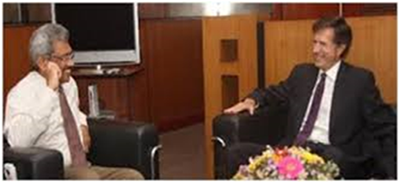 Defense Secretary Gotabaya Rajapaksa and U.S. Ambassador Robert Blake, the two signatories to the 2007 ACSA military agreement between Sri Lanka and the United States
That’s manner in which Ambassador Robert Blake cleared any doubts Washington entertained whether Sri Lanka would enter into the ACSA arrangement.
There was no indication of quid pro quo, the ACSA was signed in March 2007 by Defense Secretary Gotabaya Rajapaksa and American ambassador Robert K. Blake.
The February 2007 diplomatic cable also had a very interesting determination: “The ACSA is not a treaty and does not guarantee support will be provided. Rather, it is a streamlined process in accordance with U.S. law to provide and receive logistical support without the lengthy Foreign Military Sales process to which both parties must agree before any transaction can occur. The transaction can be in the form of cash exchange, assistance-in-kind, or even value exchange”.
There was no Quid Pro Quo. Washington blocked Sri Lanka receiving Foreign Military Sales, since the Eelam War IV commenced in July 2006 until the LTTE was defeated in May 2009 Washington drastically cut-reduced or deprived military assistance at a time Sri Lanka’s sovereignty and territorial integrity were severely under threat.
Washington’s mind-set throughout the Eelam War IV was based on the following policy determination reflected in the 31 January 2007 classified diplomatic cable sent from the U.S. Embassy Colombo to Washington: (Quote) the USG faces some risk that the Government of Sri Lanka might seek to exploit the signing to convey the USG’s support for possible ongoing offensive military operations.
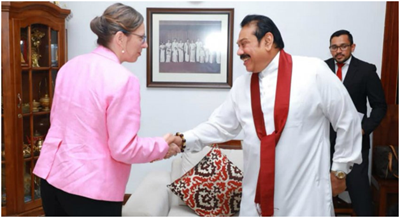 Former President Mahinda Rajapaksa in a Photo-Op with U.S. Ambassador Alaina Teplitz during their August 2019 meeting at former’s official residence in Colombo
The USG has informed the GSL that we oppose large scale offensive military operations because we believe the Government should focus on developing a power-sharing proposal that can form the basis for peace negotiations with the LTTE. (End Quote)
At the height of the separatist war Washington maneuvered to persuade the GSL to cease its military offensive to bring the non-state actor (NSA) – the Tamil Tigers – as an equal partner to the negotiating table with the legitimate government, despite in 1997 the US Department of State designated the Liberation Tigers of Tamil Eelam (LTTE/Tamil Tigers) a Foreign Terrorist Organization. Washington’s policy toward minority Tamils, national issues and GSL offensive against the LTTE was dictated by the 1984 classified document (de-classified in 2011) jointly drafted by the CIA and the State Department not to provide military support to the GSL as it could use such arms against the minority Tamils and that under such a scenario Washington may face problems in dealing with ethnic minorities in other countries.
The Acquisition and Cross Servicing Agreement (ACSA) signed between the Governments of Sri Lanka and the United States in March 2007 which allowed both countries to transfer and exchange logistics supplies, support, and re-fueling services clearly benefitted the United States in its military operation in the Asia-Pacific region – specifically US Pacific Command (USPACOM) which is now US Indo-Pacific Command (USINDOPACOM) – but left Sri Lanka with absolutely no benefit from the U.S. at a time Sri Lanka was in an intense military battle with the separatist Tamil Tigers, contrary to what presidential candidate Gotabaya Rajapaksa declared at his Colombo press conference on 14 September.
ACSAs had been particularly helpful in the conduct of the United States’ Global War on Terror (GWOT) operations. PACOM forces made extensive use of the ACSA with the Republic of the Philippines to support the Armed Forces of the Philippines operations against terrorist cells in that country.
This was never extended to Sri Lanka during its intensive military offensive against the Tamil Tigers. In fact the USG drastically cut its military assistance to Sri Lanka during that time. The US Congress used the Leahy Amendment of the Foreign Assistance Act to cut military assistance citing human rights issues.
As Gotabaya Rajapaksa has positioned himself as a serious stakeholder in Sri Lanka’s political leadership at the November 16 presidential election, he is confronted with embracing the enhanced 2017-signed 83-page ACSA – the forerunner to the 2007 agreement he signed and proclaimed in his maiden press conference on October 14 as a military pact that benefited Sri Lanka – to facilitate Washington’s militarization in the Indo-Pacific region. As a premier stakeholder in the imminent Rajapaksa administration, he will be expected to finalize the Status of Foreign Forces (SOFA) arrangement, many consider inimical to Sri Lanka’s sovereignty.
When asked about the SOFA at the October 14 press conference, Mr. Rajapaksa said “any government who wants to negotiate has to start with me.”
Since the advent of the Trump administration in January 2017, the United States has been strengthening its military might in the Indo-Pacific region coercing Sri Lanka to get in line with American military maneuvers.
In the Indo-Pacific region with the role of the United States growing more visible and prominent, the importance of USPACOM’s force sustainment plans and procedures during the time Sri Lanka entered into ACSA in 2007 was crucial. And now with the Trump Administration using the December 2018 Congress-ratified ‘Asia Reassurance Initiative Act’ the US Indo-Pacific Command needs logistic support to combat Chinese military and political expansion in the East, South and Central Asian regions. The Act, specifically, calls for America’s increased engagement in the Indo-Pacific region and strengthened support, including arms sales, for U.S. allies in the region.
The act develops a long-term strategic vision and a comprehensive, multifaceted, and principled United States policy for the Indo-Pacific region.
Establishing a logistic hub at the Trincomalee harbor and the use of the Bandaranaike International Airport in the out skirts of the capital city Colombo for logistic operation comes at a time the Trump administration puts into law Asia Reassurance Initiative Act to strengthen US strategic positions in the Asia-Pacific region.
It is in this context that Sri Lanka has become crucial to Washington, and Mr. Rajapaksa at the center of the issue now with his declaration that the 2007 ACSA was beneficial to Sri Lanka.
By Daya Gamage
334 Viewers