Navi Pillay’s gross biasness exposed
Biasness, and undiplomatic attitude and approach of Indian Tamil ethnic origin South African Navi Pillay, who is widely alleged as pro-LTTE Tamil terrorist sympathizer , High Commissioner for Human Right in the UN has been exposed by in several governments, institutions and individuals.
So called one sided and country selective UN investigation against Sri Lanka seems has been high-jacked by the outgoing High Commissioner Pillay to fulfill the pro-LTTE Tamil diaspora living in US, EU, Canada and UK. Pillay has attempted to revised and amend the resolution passed by the member countries in the UNHRC to satisfied her obligation to pro-LTTE Tamil diaspora who are infamous to buy the officials and journalists to gain their separatism and terrorism.
Out of many complaints made to UN Secretary General Ban Ki-Moon on the unprofessional behavior of Navi Pillay, a Sri Lankan origin, Canadian citizen has written the following letter to him as well.
84, Tambrook Drive
Agincourt, Ontario
Canada M1W 3L9
August 17, 2014
Hon. Ban ki-Moon, Secretary General, UNO
Copy to: President, UNHRC, Geneva
Copy to: Ms. Navi Pillay, High Commissioner for Human Right, Geneva
Hon. Ban ki-Moon,
OHCHR Investigation on Sri Lanka per UNHRC Resolution A/HRC/25/1 of March 2014
I am writing to you as a Canadian of Sri Lankan origin who is at a loss to understand the high handed manner in which senior officials on the United Nations Organization act in violation of their mandates defined by the UN Charter and Specific Resolutions which outlines the limits of authority.
It is regrettable that the UNHRC adopted the above Resolution at its sessions held in March 2014 granting the High Commissioner an investigative mandate in violation of HRC Resolution 60/251 and the IB package, which is in direct conflict with her limits of authority thereby making any findings null and void.
Furthermore, the Operative Paragraph lacks clarity when it refers to the engagement of so called ‘relevant experts’ without proper definition for the purposes of assisting the High Commissioner, leaving room to outsource the investigation to external sources as opposed to an investigation by the OHCHR, leading instead to an international investigation mechanism as a result of interpretation of ambiguous language contained therein. Also, it has to be pointed out that this Operative Paragraph which requests the OHCHR to conduct an independent investigation is clearly inconsistent with Operative Paragraph 2 which requires the Government of Sri Lanka to conduct an independent investigation into the alleged violations.
Yet another matter is the exact period to be covered by the OHCHR investigation. According to HRC Resolution A/HRC/25/1, the period to be covered by the OHCHR investigation was to be identical to that covered by Sri Lanka’s Lessons Learnt and Reconciliation Commission (LLRC), i.e. February 21, 2002 to May 19, 2009. It has now been observed that the High Commissioner has on her own extended the period of the investigation from February 2002 to November 15, 2011. This is highly irregular, and is in direct variance with the enabling Resolution adopted at the March 2014 session of the UNHRC. If at all, the Resolution should have called for the investigation of the entire period of the armed conflict which commenced in 1983 and ended on May 19, 2009, as it now leaves out a major portion of the atrocities committed by
the Liberation Tigers of Tamil Eelam prior to February 2002 and IPKF operations without any valid reason. The High Commissioner should be told in no uncertain terms that she has no authority to make material changes to a Resolution already adopted by the member countries, and should immediately take steps to rectify the period of the OHCHR investigation to coincide with the period covered by the LLRC.
If one were to consider the serious violations of Human Rights and International Humanitarian Law by major western countries in Iraq, Libya, Syria, Afghanistan and Drone attacks in Pakistan and across other international boundaries, which have been clearly established and thus proven, yet where no such international investigations have been launched by the UN or UNHRC. The selective nature of probing events in Sri Lanka based on unproven claims deemed as “Credible Allegations” raises many questions about the non-principled and arbitrary conduct of the UN body.
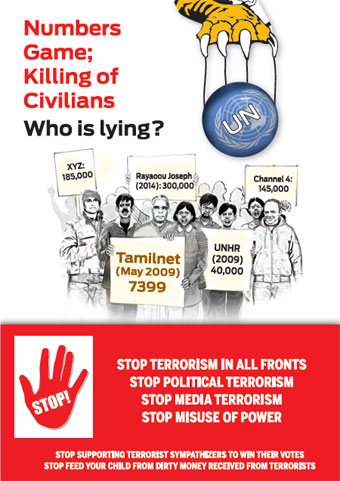
You are no doubt aware of the so called Panel of Experts on Sri Lanka appointed from outside the UN system without the authority of the UNGA, UNSC or the UNHRC, thereby exceeding the authority granted to you per Chapter XV, Articles 97 and 98, to solely advice the UNSG on issues of accountability during the final stages of the armed action taken against the internationally designated terrorist organization known as the Liberation Tigers of Tamil Eelam (LTTE), aka Tamil Tigers. This report is strangely leaked by your office, which the High Commissioner later attempts to table same at the UNHRC sessions when it had no legal standing. Needless to say, it was a one-sided inquiry conducted by panelists who had previously expressed their clear bias against Sri Lanka, that downplayed the UN Resident Representative’s count of 7721 deaths said to have occurred from August 2008 to May 13, 2009, and instead given credence to exaggerated guesstimates by rights groups located outside Sri Lanka which range from 40,000 upwards during the said period. Whereas the Tamilnet, a propaganda arm of the LTTE reported a total of 7398 deaths during the latter stages from January 1 to May 19, 2009 without distinguishing between Tamil Tiger cadres and non-combatant civilians. The census carried out by Sri Lanka in 2012 using Tamil enumerators reported a total of 7432 deaths of both cadres and civilians. The panel acknowledged that the distinction between cadres and civilians had been blurred as a large segment of the LTTE cadres battled in civilian attire.
According to the Op-Ed column written by B.S. Raghavan appearing in ‘The Hindu’ newspaper of June 25, 2010, he has stated that: “Sri Lanka is a sovereign, independent country, having the indisputable right under the UN Charter itself, to act in its best judgment on issues relating to its internal affairs, especially where maintenance of peace and security is concerned.” The double standards being applied by the UNSG overlooking glaring violations in other theatres involving major powers, and pursuing an interventionist role in Sri Lanka despite the absence of directives from the General Assembly, Security Council, or the UNHRC, will no doubt lead to the waning of confidence in the organization and making it irrelevant.
The UNSG’s Panel took the unusual step of locking up the evidence gathered for 20 years, and further declared that none of the allegations contained in their report had been proven, and that the report fell short of standards required of a UN report. Despite all of its shortcomings, it becomes the basis of Navi Pillay’s ( whose Tamil community of South Africa were active supporters of the LTTE’s separatist goals) plank to try and shame and punish Sri Lanka. Sri Lanka made six separate attempts over two decades to negotiate a peace deal, but finally used her military when a war was thrust on her by the Tamil Tigers in 2006 to eliminate three decades of Tamil Tiger terrorism in the country.
I hope that you would realize the damage done to the United Nations Organization by career oriented officials like yourself who in the pursuit of personal goals of advancement lose sight of the organization’s goals and become tools in the hands of major powers with geo-political agendas. I trust you will see the futility of the combined actions of yourself and the High Commissioner against a sovereign member country even at this stage, and rectify your ways before you do more harm to the world body of which you are entrusted to uphold fairness and evenly serve the member nations.
Yours sincerely,
Mahinda Gunasekera
857 Viewers